Thursday, March 19, 2026
- 1 [The Story of Sunflower Melon Cultivation] An epic tale of life woven over a year by farmers in Hokuryu Town.
- 2 Chapter 1: Beginnings in the Snow: February - Sowing Rootstock
- 3 Chapter 2: Techniques that sustain life: February - Grafting
- 4 Chapter 3: The Miracle of 98%: March - Seedlings after Grafting
- 5 Chapter 4: Journey to the Earth: March - Planting
- 6 Chapter 5: Guiding the Vines: April - Pinching, Pruning & Rice Sowing
- 7 Chapter 6: Choosing Life: May - Fruit Thinning
- 8 Chapter 7: A Joyful Morning: June - First Shipment
- 9 Chapter 8: Thoughts Reaching the Market: June - First Auction @ Asahikawa Local Wholesale Market
- 10 Chapter 9: Giving back to the soil: July - Compost making & spreading
- 11 Chapter 10: Summer of Learning: July - JA Kitasorachi Melon Cultivation Workshop
- 12 Chapter 11: Autumn Harvest: September - Second Crop of Red-Fleshed Melons
- 13 Chapter 12 Autumn Gifts: September - Red-fleshed melons shipped
- 14 Chapter 13: Gratitude to the Earth: November - Making Straw Compost for Melon Greenhouses
- 15 In conclusion: The story contained within each ball.
- 16 Sunflower Melon Cultivation: Complete Record
- 17 YouTube videos
- 18 Other photos
- 19 Related articles
[The Story of Sunflower Melon Cultivation] An epic tale of life woven over a year by farmers in Hokuryu Town.
The Hokuryu Town Sunflower Melon Producers' Association cultivates sunflower melons. This is a grand epic of sunflower melon cultivation, written over the course of a year by the melon farmers of Hokuryu Town (from a 2018 interview about melon cultivation).
Chapter 1: Beginnings in the Snow: February - Sowing Rootstock
In Yasunori Watanabe's seedling greenhouse, the life of the melons begins to sprout.
With spring just around the corner, and despite the continuing heavy snowfall, Watanabe Farm began setting up its melon greenhouses on February 1st. The work started with snow removal, covering the greenhouses with plastic sheeting, and preparing the soil for the seedling pots. This included filling seedling trays and pots with soil, and arranging the pots.
Rootstock melons are disease-resistant, healthy melons. They are used for grafting onto the base melon. The soil should be potting soil that is resistant to pathogens and easy to grow in. Warm the soil to 30°C, and place it in a seedling tray, loosening it to allow air in, leveling it, and making grooves at equal intervals.
Using tweezers, arrange 19 rootstock seeds in each row on the plate. If you place the seeds perpendicular to the grooves, the cotyledons will emerge sideways. Arrange 19 seeds evenly in each row of grooves. The grooves are made to prevent the seeds from moving when you cover them with soil after sowing. Gently cover the seeds with soil, flatten the surface of the soil, and then cover with newspaper.
The seedling trays, after sowing, are placed in a heated seedbed inside the greenhouse, covered with plastic sheeting and blankets, and carefully nurtured while maintaining a temperature of 30°C.
The seeds germinate three days after sowing. One week after sowing, they are transplanted into seedling pots. Once the rootstock seedlings are grown, the melon plants are sown and grown, and then the rootstock melons and the main melon plants are grafted together.
Mika, who was an agricultural intern last year and is now married to Hayato Watanabe, was also experiencing this for the first time. Watching her carefully arrange each seed with tweezers, you can see how family bonds support melon cultivation.


Chapter 2: Techniques that sustain life: February - Grafting
The art of "split jointing," a technique inherited from my master using my fingertips.
The rootstock has germinated, and while it is being transplanted into seedling pots, the sowing of the melon itself (Hokuryu No. 3 melon) is being carried out simultaneously.
Currently, Yasunori Watanabe, a certified agricultural advisor in Hokkaido, is cultivating melons without heating and shipping them early, even within Hokkaido. In 2002, he learned that there was a better grafting method than the "approach grafting" method he had been using, and learned "cleft grafting" from his mentor, Takanori Shibata of Otoe-cho (currently the chairman of the Hokuto Melon Producers' Association).
Currently, he is the farmer with the highest shipment volume at JA Kitasorachi. He also works to improve techniques by holding grafting workshops for the sunflower melon producers' cooperative in Hokuryu Town.
Grafting the melon plant onto a rootstock with strong roots results in healthy, delicious melons that are resistant to soil-borne diseases. It is also said to help prevent problems caused by continuous cropping.
First, pinch off the central bud of the rootstock and make a vertical cut from top to bottom, starting from the center of the cotyledon base. For the melon itself, cut the hypocotyl and place the sprouted melon stem on your finger, then thinly shave off the side of the stem. Do this on both sides, and the stem will be trapezoidal with parallel surfaces. Insert the melon into the rootstock and secure it with a mini clip to join them together.
With their fingertips fully focused, they carefully graft each tree one by one. It's a delicate job using a razor blade. Inside the orderly greenhouse, Mr. and Mrs. Watanabe continue their grafting work.


Chapter 3: The Miracle of 98%: March - Seedlings after Grafting
Life is sustained by a cycle of hydration and dehydration.
Grafting was carried out on February 23rd, and the seedlings in the nursery pots are growing steadily and well. When we visited on March 6th, the clips holding the seedlings in place had been removed, and the pots had been separated and rearranged.
The success rate of grafting varies from year to year, but this year it's better than usual, at around 98%. The success rate is quite high. Grafted seedlings require repeated cycles of watering and drying, at a rate of 100% or more. Once dry, water them, then re-moisten them with a sprayer and cover them with plastic again. In the afternoon, remove the plastic and let them dry for about an hour.
Repeat this process for about three days, then remove the plastic sheeting and only provide shade during hot days. It takes about 10 days for the true leaves to firmly attach and grow. Removing the buds that emerge from the rootstock is also an important task, as it concentrates nutrients into the melon itself.
"The grafting process was delicate. It's amazing to see the damaged rootstock and the main plant grow together as one," says Mika. In about 10 days, they will be transplanted into the greenhouse.


Chapter 4: Journey to the Earth: March - Planting
Jewel-like water droplets line the edge of a heart-shaped leaf.
One month has passed since sowing, and the melon seedlings are growing steadily. Three true leaves have grown firmly, and they are absorbing water, with tiny water droplets shining like jewels along the edges of the heart-shaped leaves.
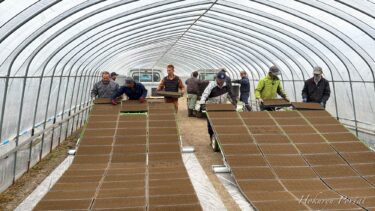
The soil in the 90m melon greenhouse is roughly tilled after spreading fertilizer. The soft, fluffy soil beds, which have been raised, are then covered with mulch film and then covered with a double layer of tunnel plastic sheeting.
This plastic sheeting helps regulate soil temperature, maintaining a soil temperature of around 16°C (at a depth of about 20cm underground). Since growth can stop if the temperature drops below 15°C, careful temperature adjustments are necessary. Apparently, the temperature inside the greenhouse can vary by 3°C depending on the thickness of the plastic sheeting.
We made cuts in the plastic sheeting at 60cm intervals and got everything ready. Before planting, we soaked the melon seedling pots in lukewarm water to hydrate them. We lined them up on the plastic sheeting, made holes by hand, and carefully planted the melon seedlings, then gently pressed them down with soil to secure them.


The sight of him kneeling
Approximately 290 seedlings are lined up in a 90-meter greenhouse. The work of planting the seedlings is done on one's knees or while sitting. Not only is the knee pain caused by keeping it bent, but as the soil temperature rises, it becomes hot enough to cause low-temperature burns. The workers continue this arduous work while wearing knee supports to protect their knees.
Since materials like vinyl, soil, and seeds evolve every year, we keep our eyes and ears open to gather information. We make improvements year after year through trial and error, learning from both successes and failures.
One month after planting, the important fruit-setting process will take place.

Chapter 5: Guiding the Vines: April - Pinching, Pruning & Rice Sowing
Growing melons and rice, two forms of life, simultaneously.
April is when the melon vines that have been planted begin to grow rapidly. Pinching and pruning are important steps to concentrate nutrients on the melon fruit.
Unnecessary vines and side shoots are carefully removed, and the direction in which the vines grow is adjusted. At the same time, rice planting also begins. Melon farmers are also rice farmers, and they spend their days from morning till night going back and forth between the greenhouses and the rice fields, with no time to rest.
At Watanabe Farm, work in the melon greenhouses and preparations for rice planting proceed simultaneously. This commitment to not cutting corners in any task is the foundation of agriculture in Hokuryu Town.


Chapter 6: Choosing Life: May - Fruit Thinning
One vine, one fruit: A decisive choice brings sweetness.
Once the melons begin to bear fruit, thinning is carried out. While the fruits are still small, the farmers carefully select and leave only the best ones, judging their shape and position. This is a moment where the farmers' years of experience and discerning eye are put to the test. Whether the netting forms nicely or the sugar content develops depends entirely on this selection.
One fruit per vine. This simple choice produces sweet and flavorful sunflower melons.


Chapter 7: A Joyful Morning: June - First Shipment
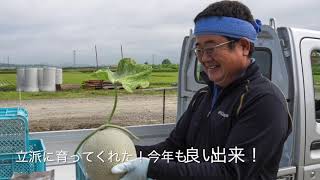
Yasunori Watanabe and Naoto Ito, it's finally time for shipment!
Approximately four months after sowing in February, the day finally arrives. The melons, carefully cultivated in the greenhouse, begin to wear beautiful netting and emit a sweet fragrance. Each melon is carefully harvested, sorted by grade, and packed into boxes.
Relief and joyful smiles appear on the faces of Yasunori Watanabe, Naoto Ito, and all the members of the producers' cooperative. This is the moment when Hokuryu Town's sunflower melons will finally be released to the world.


Chapter 8: Thoughts Reaching the Market: June - First Auction @ Asahikawa Local Wholesale Market
The sounds of auctioneers echo, the pride of Hokuryu Town's brand.
The first auction of the year takes place at the Asahiichi Asahikawa Local Wholesale Market (Asahikawa City). The sunflower melons lined up at the market are treasures filled with the year's efforts of farmers in Hokuryu Town. They will be handed over to market officials and eventually reach dinner tables.
A melon with a story behind it, where you can see the face of the producer. That's the greatest appeal of Himawari melons.


Chapter 9: Giving back to the soil: July - Compost making & spreading
To deliver delicious melons next year and beyond.
July. While shipments of the first crop of melons continue, preparations for the next crop have already begun. Straw compost is being made and spread on the fields. Mr. Watanabe has also been conducting research on compost making. High-quality compost activates soil microorganisms and creates an environment in which melon roots can grow healthily.
Soil preparation is fundamental to agriculture. The secret to the continuous improvement of melon cultivation in Hokuryu Town lies in this steady and diligent soil preparation.


Chapter 10: Summer of Learning: July - JA Kitasorachi Melon Cultivation Workshop
Yasunori Watanabe will be the instructor for the course on the transmission of skills.
JA Kitasorachi's training session on cultivating suppressed-harvest melons. Yasunori Watanabe will serve as the instructor, passing on melon cultivation techniques to the next generation and to his fellow community members.
Grafting techniques, temperature control tips, and soil preparation techniques—the willingness to share the wisdom cultivated through years of experience embodies the spirit of "sharing" in Hokuryu Town.


Chapter 11: Autumn Harvest: September - Second Crop of Red-Fleshed Melons
"Golden Pillow" - A rich sweetness unique to autumn
At Watanabe Farm, we are cultivating red-fleshed melons that are scheduled to be shipped around the end of September.
The red-fleshed melon variety is "Ogon Makura," which began cultivation in 1989. This red-fleshed melon boasts a rich sweetness. It features a deep, autumnal flavor that differs from summer melons.
Inside the greenhouse, the vibrant orange flesh of the red-fleshed melons ripens, releasing a sweet aroma. Their plump, swollen appearance truly resembles a "golden pillow."
A bountiful harvest twice a year. This luxurious blessing is made possible only through the skill and passion of the farmers in Hokuryu Town.

Chapter 12 Autumn Gifts: September - Red-fleshed melons shipped
The greenhouse bathed in the setting sun, and the final harvest.
Late September. The autumn harvest of red-fleshed melons begins.
The melons, carefully harvested in the greenhouse, are sorted, packed, and shipped out. Along with the smiles of the Watanabe family, these red-fleshed melons, which will grace autumn dinner tables, set off on their journey.
The setting sun behind the house shone with a golden glow, as if to reward us for a year's worth of hard work.


Chapter 13: Gratitude to the Earth: November - Making Straw Compost for Melon Greenhouses


The end is the beginning.
November. The melon season is over, and the snowy season is approaching once again in Hokuryu Town.
Making straw compost for the melon greenhouse is a promise for next year. We collect rice straw, let it ferment, and turn it into high-quality compost. It's no exaggeration to say that this work determines the taste of the melons next year.
The end is the beginning. The farmers of Hokuryu Town return their gratitude to the land for the past year and begin to weave the story of another year.
In conclusion: The story contained within each ball.
When you hold a sunflower melon in your hands, please remember this story.
In the depths of winter, in February, inside a snow-covered greenhouse, farmers sow seeds one by one into potting soil warmed to 30°C. Their fingertips delicately graft seedlings with a razor blade. Water droplets line the heart-shaped leaves like jewels. Their backs as they kneel and crawl through the greenhouse plant seedlings. And the smiles of relief and joy on their faces on the morning of the first harvest.
This single fruit contains a year's worth of love from the farmers of Hokuryu Town.
Grown in the fertile soil of Hokkaido and nurtured by the warm hearts of sunflowers, these sunflower melons offer a taste that, with just one bite, will surely evoke the "Japanese spirit" of Hokuryu Town.

Sunflower Melon Cultivation: Complete Record
- February: Sowing of rootstock seeds (by Yasunori Watanabe)
- February: Grafting (Yasunori Watanabe)
- March: Seedlings after grafting (Yasunori Watanabe)
- March: Planting (Yasunori Watanabe)
- April: Pinching back and pruning & sowing rice seeds (Yasunori Watanabe)
- May: Fruit thinning work (Yasunori Watanabe)
- June: First shipment (Yasunori Watanabe and Naoto Ito)
- June: First auction of the year @ Asahikawa Local Wholesale Market (Asahikawa City)
- July: Compost making & spreading (Yasunori Watanabe)
- July: JA Kitasorachi Melon Cultivation Workshop (Yasunori Watanabe)
- September: The second crop of red-fleshed melons is growing (Yasunori Watanabe)
- September: Autumn red-fleshed melons are shipped (Yasunori Watanabe)
- November: Making straw compost for the melon greenhouse.
YouTube videos
Other photos

Related articles

◇