Thursday, March 19, 2026
- 1 Prologue: A Golden Symphony Leading to the Future (2025, Present)
- 2 Chapter 1: The Inspiration of Yugoslavia and the Mothers' Movement (1979–1980s)
- 3 Chapter 2: A Field Created by Unity (1989)
- 4 Chapter 3: Trials of Floods and Bird Damage, and an Unbreakable Bond (1988-1990)
- 5 Chapter 4: Growth, New Challenges, and the Deepening Spirit of the Community (2000s)
- 6 Chapter 5: A Philosophy Rooted in the Field: The Practice of "Harmony" and "Compassion"
- 7 Conclusion: A flower that blooms forever
- 8 Source and related content
- 9 Other photos
Prologue: A Golden Symphony Leading to the Future (2025, Present)
In summer in Hokuryu Town, Hokkaido, a breathtaking golden landscape unfolds under the vast sky of the Sorachi Plain. "Sunflower Village," where 2 million sunflowers bloom, has reached its peak of beauty.[1]The sight, broadcast live by the Hokuryu Town Sunflower Tourism Association, is captivating people all over Japan and the world.[1]。
In 2026, the "Sunflower Festival" will reach a major milestone: its 40th anniversary. The powerful beats of "THE Taiko Festival in Hokuryu" and the joyous shouts of children echoing through this field today are more than just the sounds of summer festivities. They are the overture to a grand celebration marking 40 years of history, and the first movement of a story woven by all the townspeople, leading to the climactic ode of joy, Symphony No. 9.
This idyllic scene is the product of half a century of shared struggle, unwavering hope, and an unshakeable spirit of community. As we celebrate our 40th anniversary, we embark on a journey to re-examine how this golden landscape was nurtured not only from the soil and seeds, but also from the spirit of harmony and compassion of each and every townsperson. Our quest for the answer begins with an inspiration from about 50 years ago.

Chapter 1: The Inspiration of Yugoslavia and the Mothers' Movement (1979–1980s)
The origin of the story of Hokuryu Town and its sunflowers lies not in tourism promotion, but in the earnest desire of the townspeople themselves to have good health. In 1979, an agricultural cooperative employee participating in a study tour of Europe witnessed the vast sunflower fields surrounding Belgrade Airport in the former Yugoslavia. [2] [3]He was captivated by its overwhelming beauty, and at the same time, he noticed that sunflowers could be used as a source of healthy edible oil. [2]。
This inspiration from a distant land was sown in the fertile soil of Hokuryu Town. At that time, the town's agricultural cooperative women's division had already begun a "movement to protect family health," aiming to improve dietary habits based on self-sufficiency. [2] [4]The idea, brought in from the outside, perfectly resonated with the aspirations that had been growing within the community. Sunflowers were the ideal crop to achieve the goals the town had already been carefully cultivating.
This resonance culminated in concrete action in 1980 (Showa 55): the "One Household, One Are Cultivation Movement." [2]This was a grand grassroots movement aimed at producing sunflower oil as a health food and beautifying the town's environment. Amazingly, 422 farmers responded to the call and voluntarily planted sunflower seeds on a total of 4.2 hectares of land. [2]At the heart of this movement was not economic gain, but a deep "compassion" for their families and their entire community. This pure, inward-looking motivation laid the strong spiritual foundation that would later allow them to overcome numerous difficulties.

Chapter 2: A Field Created by Unity (1989)
What began as sunflower cultivation in the gardens of individual homes eventually evolved into a symbol of the entire town. The turning point was the creation of "Sunflower Village" in 1989 (the first year of the Heisei era). This event, too, did not begin with a top-down approach from the administration, but with the trust of one town resident.
A farmer, finding it difficult to manage his land due to his aging, offered to entrust 4 hectares of farmland along National Route 275 to the town and the agricultural cooperative. [2]This was a manifestation of deep trust, a willingness to entrust one's land to the local community.
The town responded to this trust with remarkable decisiveness. They immediately leased an additional 6 hectares of farmland, expanding the project. [2]And when it came to the physical construction of the sunflower field, the "spirit of harmony" of Hokuryu Town was fully demonstrated. The Agricultural Cooperative Youth Division brought together more than a dozen tractors, while staff from the Chamber of Commerce Youth Division, the town hall, the Agricultural Cooperative, the Chamber of Commerce, and the Land Improvement District all gathered together to till the soil and sow the seeds. [2]It was a magnificent concerto, transcending organizational boundaries and working tirelessly for a single goal.
From that day forward, the scattered individual sunflower fields transformed into a single, gigantic canvas of magnificent blossoms. Sunflowers were no longer merely crops for individual health, but a source of pride for the entire town, a shared identity itself. This psychological transformation is what changed the sunflower village from mere farmland into a sacred place that connected the hearts of its people.


Chapter 3: Trials of Floods and Bird Damage, and an Unbreakable Bond (1988-1990)
Just as the town's dreams began to grow, nature presented a harsh test. In 1988, record-breaking torrential rains struck the region, devastating the sunflower fields that had been carefully cultivated. [4]It seemed as though the ray of hope was about to fade, but the townspeople's spirits remained unbroken.
Then, the following year, in 1990 (Heisei 2), shortly after the sunflower village was established, a large-scale bird attack occurred, and the young sprouts were pecked at one after another. [4]The second disaster struck, as if to test the town's resolve. However, this crisis would give rise to one of the most moving stories of unity in Hokuryu Town's history.
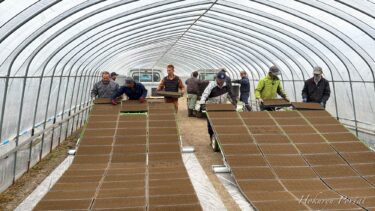
The townspeople never gave up. They began the enormous task of forcing the cultivation of 50,000 seedlings in greenhouses and then replanting each one by hand in the fields. [4]The sight of the adults silently working in the soil moved the town's middle school students. Without being asked, the students began appearing in the fields one after another and helping with the planting. Ultimately, all the students at Hokuryu Middle School joined in the activity. [4]It wasn't a planned school event, but rather a spontaneous act born from the children's genuine "compassion" after witnessing the hardships of adults.
This event did more than just save a field; it forged an unbreakable bond that transcended generations and shaped the town's future. This moving event led to the tradition of students from Hokuryu Junior High School taking on the responsibility of cultivating and managing the "World Sunflower Corner" and guiding tourists. [4] [5]The crisis transformed the children from bystanders in the town's history into active participants who would pass on its legacy to future generations. This event, which elevated the adversity of disaster into an opportunity for lasting social institutions and education, is a testament to the remarkable resilience of Hokuryu Town.


Chapter 4: Growth, New Challenges, and the Deepening Spirit of the Community (2000s)
In the 2000s, Himawari no Sato entered a new phase of growth. This involved two aspects: physical expansion and a further deepening of cooperation among the townspeople.
In May 2000 (Heisei 12), marking the dawn of the new century, the sunflower field expanded from 13 hectares to 14.5 hectares, symbolizing the town's dreams and ambitions. [6]This expansion was proof that sunflowers had firmly established themselves as an integral part of the town's identity.
However, the path to growth was far from smooth. The fury of nature repeatedly put the town to the test. On June 29, 2001, the town was hit by a massive tornado, causing extensive damage to the sunflower fields and related facilities. But the hearts of the townspeople remained unshaken. In the face of this crisis, the unity of the townspeople shone brighter than ever before. A remarkable 324 people participated in and supported a volunteer activity called the "Sunflower Village Weeding Crusade," working tirelessly to restore the fields. This "crusade" had developed from a service activity started by the senior citizens' club in 1992, and had become a proud tradition of Hokuryu Town, where residents spontaneously gather whenever they faced difficulties. [7]。
This experience served as a catalyst for elevating volunteer activities into something more organized and sustainable. The following year, in 2002, the "Sunflower Voluntary Association" was established by the townspeople, and guided tours of the sunflower village began in earnest. At the same time, a donation system was launched to support the activities, and the goodwill of visitors became the force that connected the sunflower village to the future. The great ordeal of the tornado ultimately crystallized the town's "spirit of harmony" and "spirit of compassion" into something stronger and more concrete.

Chapter 5: A Philosophy Rooted in the Field: The Practice of "Harmony" and "Compassion"
Historical Timeline: A Chronicle of Trials and Unity
| era | Important events | An expression of community solidarity ("harmony" and "compassion"). | authority |
|---|---|---|---|
| 1979 | Agricultural cooperative staff on a study tour of Europe | One person's vision was shared for the common benefit of health and beauty throughout the community. | [2] [3] |
| 1980 | "One household, one are planted" movement | 422 farming households voluntarily participated in a grassroots project focused on health and beautification. | [2] [4] |
| 1987 | The 1st Sunflower Festival was held. | In 2026, the 40th annual Sunflower Festival, a major event, is scheduled to be held. | [2] |
| 1988 | Devastating damage to fields due to record-breaking heavy rains | This demonstrated the entire community's determination to overcome adversity by rebuilding and continuing the project. | [4] |
| 1989 | "Sunflower Village" is born. | The agricultural cooperative's youth division, the chamber of commerce, and local government officials all worked together to develop the entrusted land. | [2] |
| 1990 | Severe bird damage | The entire town participated in planting 50,000 seedlings by hand. The spontaneous participation of all junior high school students was particularly noteworthy. | [4] |
| 1990–Present | Student volunteer guides | Students from Hokuryu Junior High School are responsible for managing the "World Sunflower Corner" and acting as tour guides, and the support system has been institutionalized. | [4] [5] |
| 2000 | The sunflower field has expanded to 14.5 hectares. | We realized the physical expansion of the town's dreams and ambitions throughout the entire region. | [6] |
| 2001 | Severe damage caused by tornadoes | 324 townspeople participated in the "Weed-Pulling Crusade," working tirelessly to restore the fields. | [7] |
| 2002 | "Sunflower Voluntary Association" established. | Based on our experience overcoming the disaster, we organized volunteer activities and launched a tourist guide service and a donation program. | |
| Ongoing | The annual sunflower festival | Various agricultural cooperatives, citizen groups, and companies participate as volunteers in running stalls, events, and cleaning activities. | [8] |
The core message from the leaders
A former chairman of the Himawari Tourism Association stated that the essence of this success was "a product achieved by all the townspeople," and that the most important factor was "the large number of people willing to work hard for the sake of others and for the sake of the town." [4]Those words clearly represent the spiritual pillar of Hokuryu Town.
Defining core values
- "Spirit of Harmony"This is not merely passive conformity, but rather functional and proactive collaboration. At the Sunflower Festival, a wide variety of organizations spontaneously contribute, such as the JA Kitasorachi Agricultural Cooperative Women's Division selling agricultural products, the Park Golf Association hosting a tournament, Kitasorachi Shinkin Bank conducting environmental beautification activities, and the post office selling commemorative stamps.[8]This is the living embodiment of "Wa" (harmony/Japanese culture).
- "Compassionate Heart"The episode in which junior high school students spontaneously helped out during a bird infestation is the purest expression of this spirit.[4]Furthermore, the sight of elderly people continuing to tend to fields, such as weeding, demonstrates their kindness—acting where they are needed, without expecting anything in return. [4]。

The four pillars that supported success
A former chairman of the tourism association cited the following four points as the secret to the sunflower village's rise to fame:[4]。
- It was a movement started by private citizens.Because it started with the mothers of farmers, the government had no choice but to provide serious support.
- They seized the opportunity of the times.It capitalized on the One Village One Product movement boom at the time, attracting media attention.
- There were many people with a selfless spirit.This was the biggest factor in our success.
- "Positive thinking"Sunflowers have drawbacks such as being vulnerable to rain and wind, suffering from continuous cropping problems, and having high seed costs. However, this difficulty in cultivation has actually prevented others from easily imitating them, and has become a strength that highlights the uniqueness of Hokuryu Town.
Of course, the town is not satisfied with the current situation. The town's basic plan lists the discovery of tourism resources other than sunflowers and human resource development as challenges.[9]Even the former chairman of the tourism association is sounding the alarm, saying, "We've reached the limits of relying solely on local thinking."[4]This self-awareness and forward-looking perspective suggest that the town will continue to develop.


Conclusion: A flower that blooms forever
The story returns to the golden fields. But now, the two million sunflowers we see before us are not just plants.[3][10]Each and every flower is a testament to half a century of cooperation, a memory of the moment when adversity was overcome, and a symbol of the indomitable spirit that the people of Hokuryu Town have cultivated.
What Hokuryu Town has cultivated is far more valuable than sunflowers. It is a model of community-led development, a culture of shared responsibility across generations, and a powerful testament to how beautiful and meaningful things can be created when people cooperate with a common purpose and a spirit of harmony and compassion.
This golden field is not the end of the story. It is a harvest of hope sown for future generations, and a universal lesson in the power of community, sent to the world. The sunflowers of Hokuryu Town will continue to bloom forever in people's hearts.

Source and related content
- [1] [Hokuryu Town Portal] 2025 Sunflower Blooming Status, News, etc.
- [2] [Hokuryu Town Sunflower Tourism Association] History of Sunflower Village
- [3] [Hokuryu Town Portal] Full text of the "Hokuryu Town Sunflower Tourism Association 50th Anniversary Commemorative Publication" now available digitally.
- [4] [Hokuryu Town Portal] Memories of the Tourism Association: Mr. Tsutomu Sakou, former chairman of the Hokuryu Town Sunflower Tourism Association
- [5] [Hokkaido Prefectural Government] Introduction of Tourist Volunteer Guides (Hokuryu Town Sunflower Guides)
- [6] [Hokuryu Town Portal] Tourism Promotion Volunteers, etc. 2
- [7] [Hokuryu Town] Basic Plan for Sunflower Village
- [8] [Hokuryu Town Sunflower Tourism Association Official Website]
- [9] [Hokuryu Town Portal] Hokuryu Town Sunflower Tourism Association 50th Anniversary Commemorative Publication
- [10] [Hokuryu Town Portal] Sunflower Village Timeline
Other photos

◇