Wednesday, February 18, 2026
- 1 25th Genki Village Dream Rural School Lecture 2026: "Living by 'If you need help, ask someone close to you'" by Natsumi Noya, Umaji Kobo
- 1.1 A journey that began with a sense of guilt about spending too much
- 1.2 An encounter with a working horse that changed his destiny
- 1.3 Without a job, he went on a bicycle trip to see the "production sites"
- 1.4 Creating mountains with my partner, Hupe, looking 500 years into the future
- 1.5 [Dialogue with the audience and Q&A] Warm laughter and curiosity
- 1.5.1 Sticky note: Where does the name Fupé come from?
- 1.5.2 Sticky note: How long do horses live?
- 1.5.3 Sticky note: How do you get around? Horse-drawn carriage?
- 1.5.4 Sticky note: I heard that your research topic in university was "octopus," but why "octopus" and not horse?
- 1.5.5 Sticky note: How do you make a living? Can you make a living?
- 1.6 Conclusion: Horses have a place in the workplace
- 1.7 Commemorative photo taken with everyone
- 1.8 A prayer for "self-production and self-consumption" that resonates with the spirit of Hokuryu Town
- 2 YouTube videos
- 3 Other photos
- 4 Related articles
- 5 Related Sites
25th Genki Village Dream Rural School Lecture 2026: "Living by 'If you need help, ask someone close to you'" by Natsumi Noya, Umaji Kobo
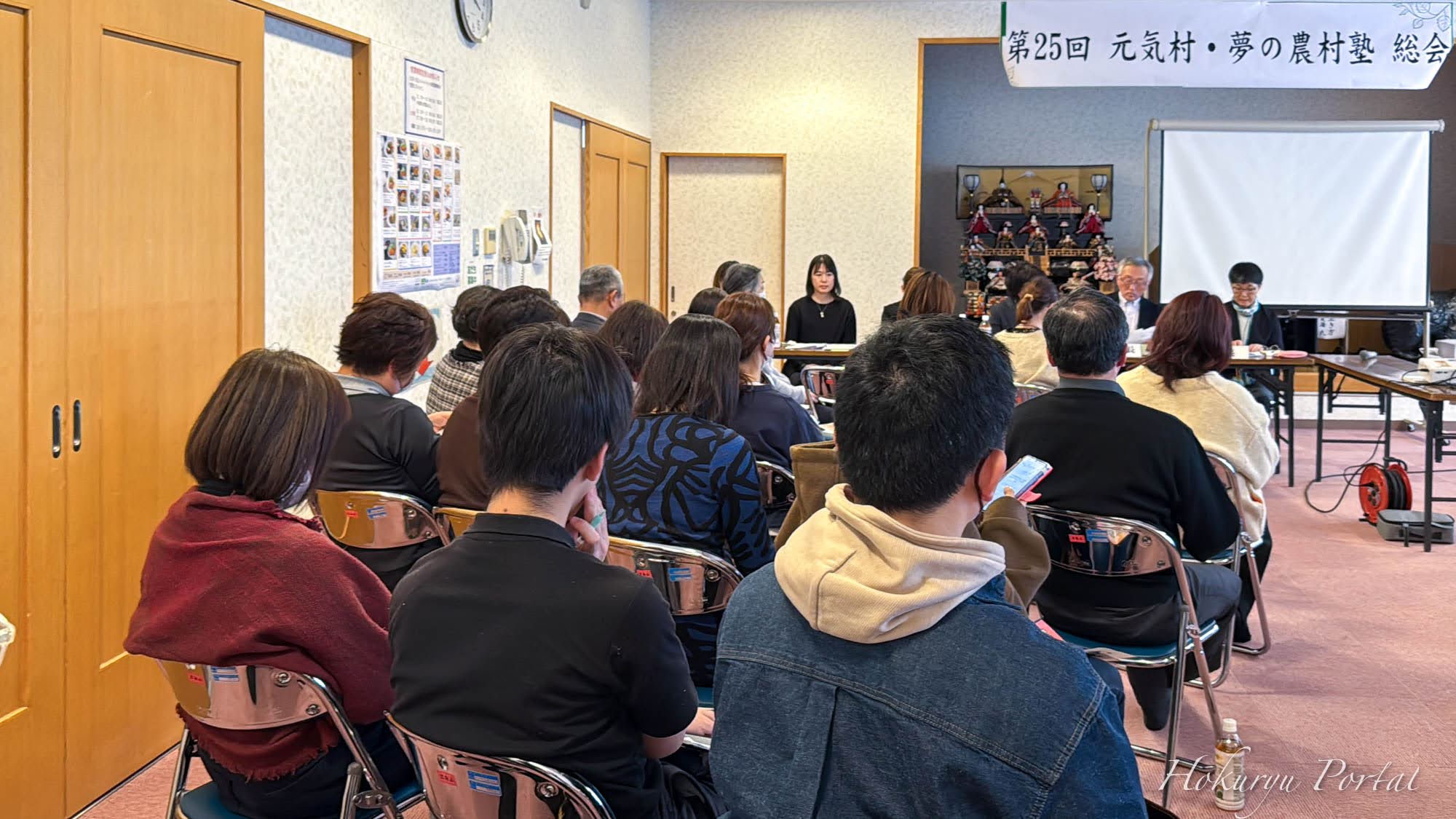
The year is 2026, and Hokuryu Town is beginning to feel the signs of a thaw. The venue for the 25th Genki Village Dream Rural Academy was filled with a quiet, passionate atmosphere. The lecturer this time was Natsumi Noya, who runs the Baji Kobo in the neighboring town of Fukagawa. Next to her still-childlike smile was her beloved horse, Houpe, projected on the screen.

If you need help, ask someone nearby
The title of her speech conveyed a concept that goes beyond mere mutual help, and is about the ultimate form of community woven by independent individuals. She spoke for about an hour and a half, and it was a quiet yet powerful message that awakened the "touch of life" that we have almost forgotten.
A journey that began with a sense of guilt about spending too much
Ms. Natsumi Noya
Hello everyone. As you may have heard, my name is Natsumi Notani, and I work under the name "Baji Kobo."
Today I would like to talk about the topic "If you need help, it's better to rely on people close to you," which sounds a bit like the title of an enka song (lol).
I'm sure most of you don't know me, so let me start by introducing myself and giving you some background on who I am and why I now live with horses and mountains.
I was born and raised in Zenibako, Otaru, a place surrounded by the sea and mountains. I currently live in Otoecho, Fukagawa, and will be turning 30 this year.
What I am doing now is inheriting the forest that my grandfather owned in Fukagawa city, and I live with my horses while managing the mountain. "Managing the mountain" may not sound like much to you, but I use the wood cut from the mountain and take care of the forest with my friends.
As you can see in the photo on this slide, he also visits local nurseries with his beloved horse, Hoope, and does things like "eco-weeding," where he has his horse mow the grass in his own garden.
The conflict that all consumption behavior creates an "environmental burden"

Why did I choose this kind of life?
The origin of this was actually my awareness of the environment. Influenced by my parents, I loved animals from a young age, and often went to the nearby horse riding facility and zoo. In that environment, I naturally became interested in where the food and things around me come from.
A major turning point for me was living alone during my university years.
Leaving my parents' home and having to buy everything I needed for myself. Buying ingredients at the supermarket, taking the bus or train to get around. Each of these actions strangely bothered me.
"How were these vegetables grown?" "How much CO2 is emitted when I travel?"
As someone who was very environmentally conscious, I felt a conflict that almost felt like guilt about the fact that all of my consumption behavior in order to survive was an "environmental burden." I felt a sense of anguish, as if I was polluting the Earth just by being alive.
Discovering "Slow Food" and finding the answer
It was during this time that I came across the idea of "Slow Food," a social movement that originated in Italy and values "delicious, clean, and fair" food.
What struck me was the perspective of "thinking outside the plate." It's not just about the food in front of you, but also about the process it went through before it got to you, what kind of feelings the producers had when they made it, and what the impact is on the environment. After thinking about this deeply, I arrived at a simple answer.
"In any case, the answer is to produce and consume locally."
Transporting produce from far away takes energy, but buying from a local person you know gives you peace of mind and also supports the local community.
And the topic of this lecture is "If you need help, ask someone close to you."
This doesn't mean "relying on others for everything." It means "basically doing things yourself (producing and consuming your own food)." However, when there's something you just can't do on your own, instead of relying on a large, distant system, you get help from people close by who you know. I realized that this is the ideal way of life for me, one that's kind to both the environment and my heart.
An encounter with a working horse that changed his destiny

With this mindset, there is another major element that makes up who I am today: horses.
When I entered Hokkaido University, I joined the equestrian club without any hesitation. There, I spent time mainly with thoroughbreds, horses with slender legs, tall, and fast running. I became completely immersed in the appeal of equestrian sports as a sport, watching them jump over obstacles and taking graceful steps.
However, I wanted to learn more about horses, so after graduating I went on to graduate school at Obihiro University of Agriculture and Veterinary Medicine. There I had a shocking encounter that changed my life. I was visiting a forestry worker's worksite as part of an extracurricular activity. There I saw a "draft horse" with thick, powerful legs that were completely different from thoroughbreds.
The horse was pulling the heavy logs cut from the mountain with just its body. When I saw this scene, called "horse transport," I was moved as if struck by lightning.
With horses, local energy production and consumption becomes possible
What do you think horses use for energy? It's not gasoline or electricity.
They eat the grass that grows nearby. They move their huge bodies by eating the grass, and they bring energy to humans in the form of firewood and timber. Don't you think that's amazing?
With horses, not only can we have food, but we can even produce and consume energy locally. This is when my pursuit of a low-environmental-impact lifestyle and my love for horses came together.
"If you're going to need someone close to you," this saying also includes our partners, horses. Instead of relying on gasoline from a distant oil field, we rely on horses grazing nearby. This is the future I'm aiming for.

Without a job, he went on a bicycle trip to see the "production sites"

After graduating from graduate school, while everyone around me was getting jobs, I decided that I didn't want to look for a job (lol), so I set off on a bicycle trip.
The goal was to "learn about the production site of the food I eat." Instead of focusing on tourist attractions, I visited organic farms and ranches. A farm in Mikasa City, a shorthorn cattle producer in Erimo Town, a farm in Toyoura Town that practices horse-drawn plowing...
What I found interesting there was not the farming itself, but rather the "lifestyle." What tools were they using to cook, what kind of conversations were being exchanged among family members? Every day I got to experience firsthand the kind of "culture" that exists in each household. These experiences have become the foundation of my life in Fukagawa today.
After that, I worked for a forestry consulting company in Sapporo for about a year and a half, but then I had the opportunity to move to Fukagawa, where my grandfather's mountains are located.
Creating mountains with my partner, Hupe, looking 500 years into the future

Currently, I manage a mountain in Otoe-cho, Fukagawa City, covering a total of approximately 10 hectares, including 5 hectares of artificial forest and 5 hectares of natural forest.
"10 hectares" may sound like a large area, but it's not nearly enough to make a living from forestry alone. However, I don't want to become a large-scale forestry worker.
Maintaining mountains, especially thinning artificial forests, is like cultivating a tree field. Without proper care, the trees become crowded and spindly, unable to develop roots and prone to falling over. By thinning them out little by little, light can be let in, allowing the trees to grow thick and strong. This is work that needs to be thought of over a span of 50, 100, or even 500 years.
And my partner is "Hoope."
Born at a pension in Nakafurano, this girl is of Hokkaido Japanese breed (Dosanko). She is only one year old (at the time of the lecture) and is in her tomboyish prime. My encounter with her was fate. I have been taking care of her ever since she was born while working part-time as a live-in staff member at the pension.

Don't expect anything, just wait
The most important thing when raising a horse is"Don't expect anything"If you have expectations of what you want a horse to do or what you want it to do, and the horse responds differently, you may become frustrated or disappointed. These emotions are immediately conveyed to the horse.
So, I don't expect anything, but I trust it."wait"I keep telling the horses that they don't need to be afraid of humans. When I tell them this, they always become curious and come closer. When Houpe started walking slowly behind me, I was thrilled and thought, "Ah, I got it."
Right now, I'm still too small to carry heavy wood, but in the future I hope to go into the mountains with my girlfriend, bring out wood by horse, and make a living from that wood. That's my dream: to create a cycle of "self-production and self-consumption."


[Dialogue with the audience and Q&A] Warm laughter and curiosity

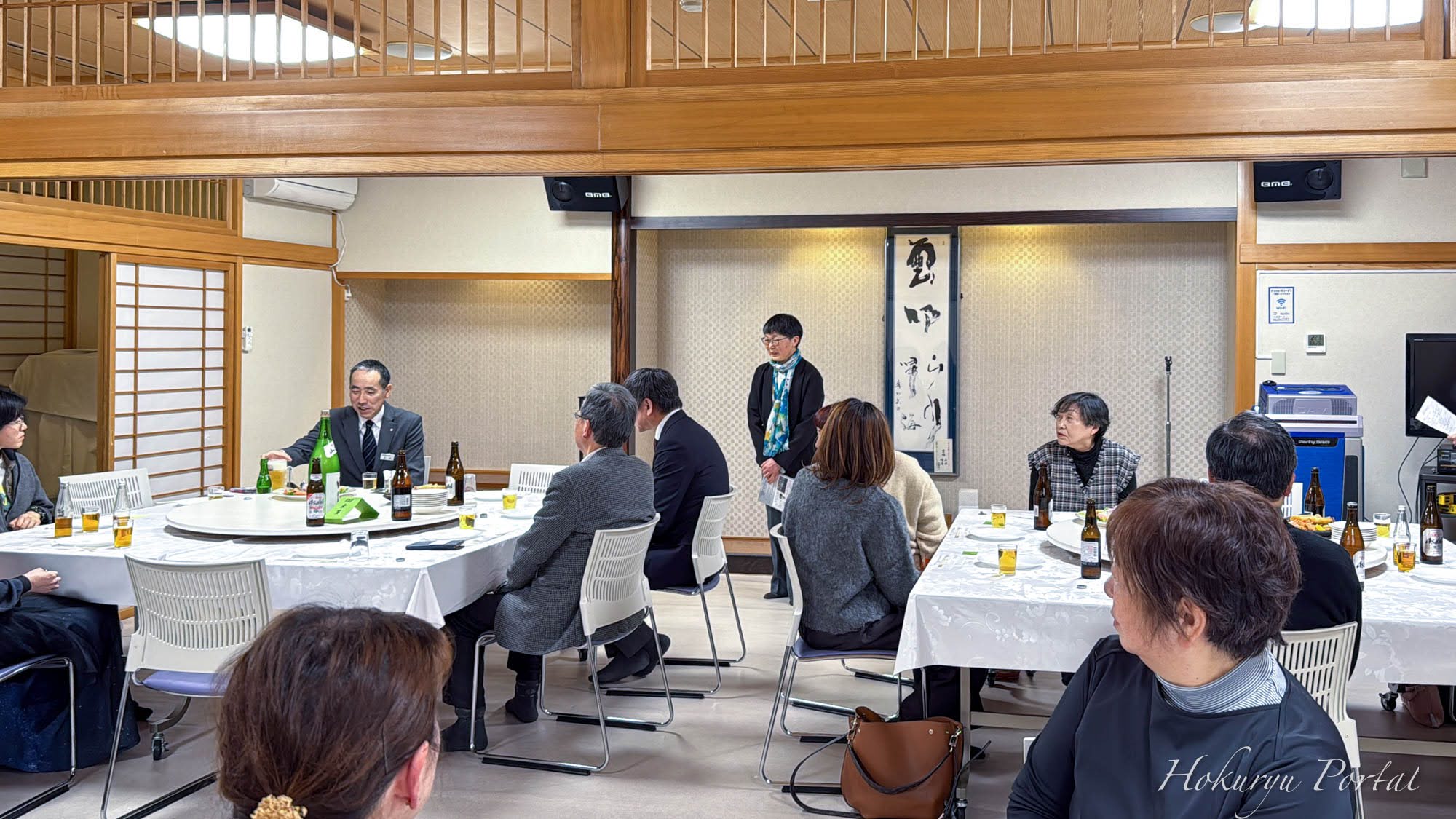
The second half of the lecture consisted of a session where questions collected on sticky notes from the audience were answered. Noya was surprised at the number of questions he received, saying, "I didn't expect to receive so many!" This showed the high level of interest in the lecture.
Sticky note: Where does the name Fupé come from?
Noya:
I'm often asked this question, but I'd like to say that it actually means "Todomatsu" (Japanese Todo Pine) in the Ainu language (laughs). To tell you the truth, I met him at a pension in Nakafurano that I happened to visit, so he's called "Fupe" (laughs). I felt that if I put too much weight into the name, it would become "expectations" and become a burden for the horse. I chose the name because I thought it was easy to call and has a cute ring to it, so light-hearted.
Sticky note: How long do horses live?
Noya:
It's roughly 25 to 30 years. In human terms, they reach adulthood at the age of three, and then age at about three times the speed of a human. I've been with Hoope for a long time. By the time I turn 60, she'll be an old lady horse. I want to live with her until the very end.
Sticky note: How do you get around? Horse-drawn carriage?
Noya:
Oh, we came in a camper today (laughs). Actually, we modified the inside of an old camper so that we can load a horse into it. It's called a "horse trailer." Everyone is surprised by this, but Hoope has gotten used to it and can easily hop in by himself. It's a "mobile stable" that we can take with us wherever we go.
Sticky note: I heard that your research topic in university was "octopus," but why "octopus" and not horse?
Noya:
(Laughter from the audience) I'm glad you asked! At Hokkaido University, I couldn't get into the biology lab I wanted, and ended up in the physics department, but I couldn't give up, so I snuck in and joined a lab that studied water octopuses. Octopuses are amazing. They've evolved in a completely different way from humans, yet they're incredibly intelligent and even seem to have emotions. It felt like I was having a conversation with an alien from the deep sea. Although the subjects are different, in terms of "how to communicate with someone (a different species) who doesn't speak the same language," it may be similar to my current life with horses.
Sticky note: How do you make a living? Can you make a living?
Noya:
That's a sharp question (laughs). To be honest, it's hard to make a living solely from horses. Right now, I combine selling timber from the mountains, working part-time in forestry, and having the opportunity to interact with horses at events. I also make use of subsidies from the national and prefectural governments. The current issue with forestry is that its industrial structure is dependent on subsidies, but I'm trying to use what I can wisely and gradually create a system where I can run solely on the earnings from my horses. We can't live luxuriously, but we have enough to eat, and above all, I feel richer in my heart. National health insurance taxes sometimes try to kill me (laughs), but somehow I manage to survive!
Conclusion: Horses have a place in the workplace

Noya:
Finally, I am often told, "It's a shame for horses to have to work," but I think the opposite is true. Horses' place is in "work."
Horses used to be a part of the family, playing a key role in farming and transport. Now, with the advent of mechanization, these roles have been lost, and horses are left with no other options but to be kept as pets, racehorses, or for food.
I want to give horses back their role as "workers." Being useful to someone, being appreciated, and being needed is what I believe is the greatest happiness and survival strategy for horses.
"If you need help, ask someone close to you."
If you ever find yourself in trouble with mowing the lawn or carrying a small load, I hope you'll think, "Maybe I should ask a horse instead of a machine."
"Thank you very much for your time today," said Natsumi Noya with a gentle, kind smile.
(The audience erupts in applause.)
Commemorative photo taken with everyone

A prayer for "self-production and self-consumption" that resonates with the spirit of Hokuryu Town
After the lecture, it was impressive to see everyone in the audience smiling and saying things like, "I was inspired," and "I want to share this with my grandchildren."
Noya spoke of "self-production and self-consumption" and "face-to-face mutual aid." In an age where efficiency and speed are all that is required, she taught us the richness of "waiting." Surrendering oneself to the rhythm of nature and waiting with trust. It is at this point that the true harvest lies.
The story of the little horse and the young woman in the forests of Fukagawa has just begun. However, this story will surely serve as a guidepost for the future we should strive for - "a world where people can live in harmony as people and as part of nature."
May the future journey of Noya Natsumi, Hoope, and Bajikobo be filled with light. And may the warm light of harmony be lit in the hearts of all who read this article.
With boundless love, gratitude and prayers, we write about Natsumi Noya's wonderful outlook on life, living in harmony with nature with the spirit of "self-production and self-consumption," as well as her deep love and trust as she quietly "watches over" and "waits" for her beloved horse, Hoope!
YouTube videos
Other photos

Related articles

Related Sites


◇