Monday, October 25, 2021
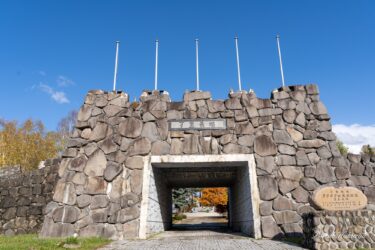
At 2:00 p.m., we met with Kameda Shinji, chief of the Policy Promotion Division of Shimokawa Town Hall, and visited the town revitalization center "Komorebi."
- 1 Town Revitalization Center "Komorebi"
- 2 Shimokawa Town: Towards a sustainable local community - Shimokawa, the SDGs Future City
- 3 Ichinohashi Bio Village
- 4 Hupu Forest
- 5 Shimokawa Town Regional Exchange Facility "Yokkuru in the Forest"
- 6 Yokkuru Garden
- 7 Other photos
- 8 Related articles
- 9 Shimokawa Town
Town Revitalization Center "Komorebi"
"Komorebi" is a town information center that connects things, events, and people.

Museum map
Tenant organizations include Shimokawa Hometown Industry Cooperative, Shimokawa Town Industrial Revitalization Support Organization Town Promotion Promotion Department, NPO Shimokawa Tourism Association, and JA Kitaharuka Shimokawa Branch (located adjacent).

Tourist Information Center

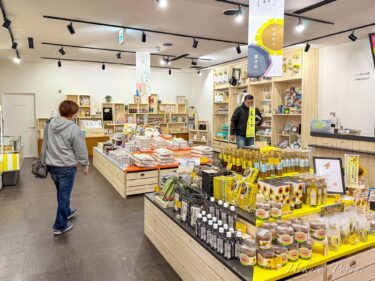
An exhibition room for local specialties and works made by artisans

Shimokawa Town: Towards a sustainable local community - Shimokawa, the SDGs Future City
At the Planning and Development Office in the Komorebi Building, Chief Kameda Shinji of the SDGs Promotion Strategy Office, Policy Promotion Division, gave a presentation on Shimokawa Town's initiative, "Towards the realization of a sustainable local community - Shimokawa, an SDGs Future City." Aya Kameda of the NPO Shimokawa Tourism Association also attended.

- What kind of town is Shimokawa?
- Past efforts (up to 2015)
- Future initiatives (2016 onwards)
- Partnerships with various entities
- Why incorporate the SDGs?

What kind of town is Shimokawa?
Overview of Shimokawa Town
- "Shimokawaism" continues to take on crises and difficulties
- Towards realizing a sustainable local community
- Recycling-based forest management
- Cascading use of forest resources to make the most of the blessings of the forest
- Forest-based society: Integrated improvement of economy, society and environment
- Ichinohashi Bio Village Model Environmental Future City Model:
The Ichinohashi district of Shimokawa Town was a small village with a population of 95 people (51.6% elderly population) in 2009. In 2010, work began on revitalizing the village, creating an energy self-sufficient residential area to address the needs of a super-aging population.
Constructed housing complex (26 units), heat supply facility, community restaurant, community center (post office, police station, common space for residents, special forest product cultivation research center, container seedling cultivation, medicinal plant seedling cultivation, etc.)

Past efforts (up to 2015)
Creating a new flow of people towards sustainable communities
- Introducing the "Regional Revitalization Cooperation Team" to revitalize marginalized communities
- Activities: Demolition of abandoned houses, ICT monitoring, lifestyle and shopping support, snow removal, local restaurant management, greenhouse cultivation, stone oven pizza sales, product development, functional plant cultivation, environmental conservation, support for disability support facilities, support for community support NPOs, facility management, water source management, etc.
- Recent years: A woodworker moved here in 2016, a former local revitalization volunteer started a business in 2017, and someone hoping to start a business processing Ezo deer moved here in 2018.
- The population will remain roughly the same, but the working-age population will increase. The aging rate will halve from 51.6% in 2009 to 25.6% in 2021.
Recent trends
- Active immigrants: Hupu no Mori Co., Ltd., NPO Forest Life, forestry x chainsaw art, woodworking
Initiatives and Results
- Shimokawa Town receives the Prime Minister's Award at the 1st Japan SDGs Awards in 2017
Future initiatives (2016 onwards)
basic
- Aiming for a sustainable "Shimokawa" by utilizing and developing local resources (forest resources, etc.) to the maximum extent and with the greatest efficiency.
Regional development incorporating SDGs Expanding positive trends and solving future problems
- Shimokawa Town's Vision for 2030 Shimokawa's SDGs

6th Shimokawa Town Comprehensive Plan (Top-level Plan) 2030 Vision Implementation Plan
- Positioning as a planning objective
- Positioning the 2030 Vision as the future
- Setting indicators for the desired state
- Identifying relevant SDGs for each policy area
- What we want to be
- Initiatives (business)
Shimokawa SDGs Indicator
- Jointly developed by Shimokawa Town, Hosei University, and the Institute for Global Environmental Strategies (IGES)

Shimokawa's approach to achieving the SDGs
- Economy: Creating a circular economy
- Society: Creating a sustainable city
- Environment: Creating a decarbonized society
Partnerships with various entities
Movements resulting from the adoption of SDGs

Regional Partnerships
- A group of volunteer residents who are considering how to realize their ideal state
- Workshop to consider the future of Shimokawa
- Shimokawa Living Network (women's empowerment and a supportive society)
- Shimokawa SDGs Map Creation
Outside the region Partnership
- A mutually complementary and supportive co-creation relationship
- Mitsui Fudosan, Yoshimoto Kogyo, BP Japan, Unilever Japan, Tokyo Tatemono, Institute for Global Environmental Strategies, Hosei University, Yokohama City and Sapporo City
Yoshimoto Kogyo Co., Ltd. Developing connections through SDGs
- 2017 1st Japan SDGs Award:
Shimokawa Town received the Prime Minister's Award, and Yoshimoto Kogyo Co., Ltd. received the Partnership Award! - Creating a good example of SDG collaboration through "local arts" and "entertainment arts"
- project"Shimokawa Town Co., Ltd." was founded!
- The power of laughter has been used to revitalize the community, spreading smiles in Shimokawa and realizing the production and performance of "Shimokawa Forest Comedy" (performed on October 12, 2019) created by all the residents.
- To promote the charm of Shimokawa, the film "Restart" directed by Hiroshi Shinagawa was produced and set in Shimokawa Town (released nationwide on July 16, 2021).
- Akira Ishida's four-frame comic "Tomato Manzai Artist Shimokawa Haruka Eight"

Why incorporate the SDGs?
- Utilizing the SDGs as a tool for urban development and regional revitalization to realize a sustainable Shimokawa
- Spreading Shimokawa's case studies and models domestically and internationally, contributing to the achievement of the SDGs
Adopting the SDGs to make Shimokawa a sustainable town (2016-2021)
- Checklist:Discover new issues and gain new insights by reexamining the region through the 17 goals
- Backcasting:We will look at the present from the perspective of the future (future vision) and implement high-quality urban development by taking steps to realize this vision.
- Branding:Communicating visions and initiatives through the SDGs framework will lead to improvements in brand and presentation.
- partnership:Meeting various people and collaborating to create new developments
"Shimokawa Challenge" connects people and nature to Mii
Shimokawa: A town that continues to take on challenges through co-creation with diverse people

Thank you for sharing so many wonderful stories that show the passion of Shimokawa Town as it continues to move forward towards a sustainable local community.

A view of the courtyard of the town development center "Komorebi," a facility where town information is gathered and connected.

Ichinohashi Bio Village
After the briefing, we moved to Ichinohashi Bio Village.
Ichinohashi Housing Complex
Ichinohashi Bio Village is an energy self-sufficient residential area that responds to the rapid aging of society.
The collective housing complex consists of 22 homes connected by a rowhouse-style outdoor corridor. They range from 1LDK to 3LDK, and all hot water and heating in the homes is supplied by a wood biomass boiler.
Ichinohashi Housing Center
The Ichinohashi Housing Center building houses a post office, a police station, and a shared space for residents.

Inside the housing center, Chief Kameda explains the area while looking at a map showing what the town looked like at its peak.

Ichinohashi residential area
Overall layout plan

Concentrated housing layout
A layout of the collective housing complex connected by a corridor from the housing center.

Corridors inside and outside residential buildings

A residential complex surrounded by greenery and lined with footpaths

Local Cafeteria (Station Cafe Ichinohashi)

Ichinohashi District District Heat Supply System

Wood fuel silo (raw chips)

Wood biomass boiler (raw wood chip-fired hot water boiler)

Control device

Hot water piping

Wood biomass boiler
Chief Kameda explains.

Ichinohashi District District Heat Supply System
A system in which wood fuel is transported from a silo equipped with an automatic supply device to a boiler's combustion furnace using a conveying device, and the combustion energy is converted into hot water for supply.

Shimokawa Town Special Forest Products Cultivation Research Institute
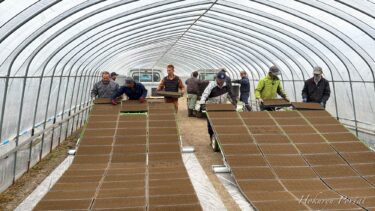
Shiitake mushroom cultivation greenhouse
Shiitake mushrooms are grown on a bed of mushrooms in a greenhouse heated with heat from a wood biomass boiler.

Shelves lined with mushroom beds made from sawdust
Controlling temperature, humidity, wind, and the number of days of cultivation are important elements of cultivation.

Thick shiitake mushrooms growing on a mushroom bed

Inside the greenhouse, rows of well-maintained mushroom bed shelves line the ground.

Workshop entrance

Packing work

Shiitake mushroom specifications table

Shimokawa Shiitake "Mori no Kiwami" (grown on a bed of mushrooms)
These are carefully selected, thick, and beautiful shiitake mushrooms.

Four shiitake mushroom greenhouses were installed

Hupu Forest
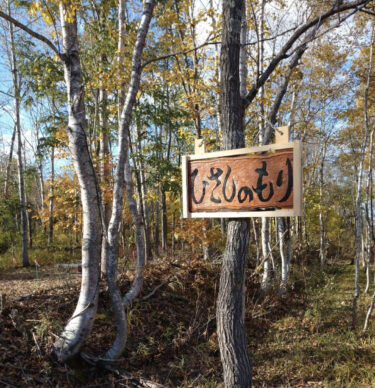
After that, we headed to Fupu no Mori Co., Ltd.
Factory tour of Fupunomori Co., Ltd.
We make essential oils using the branches and leaves of the coniferous tree "Todomatsu" (Japanese Sakhalin fir) found in "Fupu no Mori" forest in Shimokawa town.

- The Shimokawa Town Forestry Association's essential oil business, which was established in 2000, was taken over by the town's NPO Mori no Seikatsu, and in 2012, "Fupunomori" Co., Ltd. was established as a company solely engaged in the essential oil business.
- In 2015, he launched the lifestyle brand "NALUQ."
- In 2016, the NALUQ Cosmetics Line won the grand prize at the Social Products Awards 2016.
* Todomatsu (abies) is an evergreen tall tree of the genus Abies in the family Pinaceae. Its cone-shaped tree and beautiful fresh green leaves make it popular for Christmas fir trees and New Year's pine decorations.
A talk by Representative Director Marie Tanabe
Marie Tanabe moved to Shimokawa in 2007. She has always loved and used essential oils, but when an employee at her company retired, she decided to take over the job and join the company.

"The essential oil is extracted from the leaves of the Todo fir tree.
Shimokawa is a forestry town, so we started this project to make effective use of branches cut down during forestry. This year marks the ninth year since the establishment of "Hupu Forest." "Hupu" means "Japanese Sakhalin fir" in the Ainu language.
We go to the forests where trees are being cut down, carefully cut and collect the leaves of the Japanese Sakhalin fir by hand, and fill baskets with them to use as raw materials.

During the distillation process, the raw materials are placed in a kiln and steamed with steam. When the steam is cooled, it returns to a liquid and the aromatic distilled water is extracted. The two layers are extracted: the oil on top and the distilled water on the bottom. The leaves after distillation are also dried and some are used effectively, such as for making pillows. The rest is used as compost.
"Originally, fir tree oil was used daily overseas, in places like Russia and Europe. It is known to be effective for saunas, respiratory care, cold prevention, and promoting blood circulation," says Tanabe.

Oil and distilled water are extracted using steam distillation.

"FUPUNOMORI" series
A lineup that captures the refreshing scent of Hokkaido fir and the scent of the forest as much as possible.

"NALUQ"
A forest lifestyle brand that lets you enjoy the scent of Hokkaido's forests.

"Inspired by the image of the forests of Hokkaido, this natural essential oil is a blend of various scents based on forest plant ingredients.

"When you think of the scent of Hokkaido, you think of peppermint and lavender, but the scent of Sakhalin fir is a fresh, forest scent with a light, foreign feel. I hope it will come to be recognized as the third scent of Hokkaido, evoking a sense of nostalgia," said Tanabe.
After completing all the schedules for the day, we had an evening get-together at "Yuzurutei" with Mr. and Mrs. Kameda and Mr. Seki. Thank you for a meaningful and enjoyable time.
Shimokawa Town Regional Exchange Facility "Yokkuru in the Forest"
On this day, we stayed at Mori no Naka Yokuru, a Shimokawa town community exchange facility. Mori no Naka Yokuru is a cottage that is fully equipped with everything you need for daily life, including a kitchen, and is suitable for long-term stays. The NPO Mori no Seikatsu is the designated manager and operates Yokuru.
living

The panel heaters installed in each room are supplied with hot water from a wood biomass boiler, keeping you toasty warm!
Panel heater thermo handle

Panel heater installed under the window

kitchen

kitchen utensils

A set of pots

Complete set of tableware

Dressing room (with sink and washing machine)

bathroom

toilet

Bedrooms (2 rooms)


Yokkuru Garden
The next morning, after a good night's sleep and waking up feeling refreshed, Seki showed us around the Yokkuru Garden on the premises.

At Yokkuru Garden, vegetables and herbs are grown using permaculture, pesticide-free, chemical-free fertilizer-free, and natural farming methods.
Guests can pick vegetables from the garden and eat them for breakfast. What a wonderful idea!
Unfortunately, when I visited, most of the vegetables were gone.
If you visit in the height of summer, you might be able to find lots of delicious vegetables...
I'm looking forward to it!!!


I would like to express my sincere gratitude to all those involved in leading Shimokawa into a great town with a bright and expanding future.
With boundless love, gratitude and prayers for the wonderful town of Shimokawa, where we coexist with nature, life circulates, and everything is connected...
Other photos
▶Photos (242 photos) from the Shimokawa and Hokuryu exchange event can be found here >>
Related articles
◇ Photography and editing: Noboru Terauchi Interview and text: Ikuko Terauchi
Shimokawa Town
[Shimokawa Town Hall]
63 Saiwai-cho, Shimokawa-cho, Kamikawa-gun, Hokkaido
Tel: 01655-4-2511
[Area] 644.2k㎡
Population: 3,124 people, 1,687 households
[Number of Tourists] 2019: 92,390 people (Gomi Onsen, Great Wall, etc.)
[Events] 2019: 16,200 people (Udon Festival, Ice Candle Museum, etc.)From the Town Directory (2020 edition)」
[Homepage]Shimokawa Town -Northern Hokkaido, a town where excitement is born-