Monday, March 16, 2026
- 1 Nanatsuboshi Cultivation Record: The First Brushstroke Towards Abundance Painted on the Snowfield
- 2 Overview of Mizuho Corporation
- 3 Morning meeting: Encouraging visit from Mayor Yasuhiro Sasaki
- 4 Spreading de-icing agents: The first job to usher in spring.
- 5 Dense Seedling Cultivation: A cultivation technique from Hokuryu Town that will shape the future.
- 6 Ready Reserve Self-Defense Force Personnel: A New Way of Working that Connects Agriculture and National Defense
- 7 R8 Work Schedule: A Yearly Agricultural Calendar
- 8 Dense seedling cultivation management: A fusion of science and experience
- 9 Mizuho's fields: an overview of approximately 100 hectares.
- 10 The one-year voyage begins.
- 11 YouTube videos
- 12 Other photos
- 13 Related Sites
Nanatsuboshi Cultivation Record: The First Brushstroke Towards Abundance Painted on the Snowfield
On Saturday, March 14th, Hokuryu Town was covered in a blanket of white snow. The temperature was 4-5℃, a morning when the lingering traces of winter were still very much present.
Mayor Yasuhiro Sasaki of Hokuryu Town visited Mizuho Bank's office to offer encouragement. His visit coincided with a meeting that started at 8:00 AM.
This year, the Hokuryu Town Portal will be following Mizuho Co., Ltd.'s rice cultivation (dense seedling method, Nanatsuboshi variety) for a full year. In this first installment, we start with the beginning: the application of snowmelt agent.
Overview of Mizuho Corporation
Mizuho Co., Ltd. is an agricultural corporation based in Hokuryu Town. It was reorganized in January 2023 from the former Mizuho Agricultural Cooperative Corporation, and Masami Komatsu serves as its Representative Director and President.
- Representative:Representative Director: Masami Komatsu
- address :37-5 Umitani, Hokuryu-cho, Uryu-gun, Hokkaido 078-2513
- Phone:080-5597-2390
- FAX:0164-34-2390
- mail:a5k5jr@bma.biglobe.ne.jp
- HP:https://www.instagram.com/kabushikigaishamizuho
- Directors:5 people,employee:5 people
- Cultivated items:Rice: 10,054 ha, White soybeans: 470 a, Buckwheat: 1,716 a, Sweet corn: 61 a
- Job postings:No. 336 Mizuho Co., Ltd. [Hokkaido Agricultural Human Resource Development Center]


The farm manages approximately 100 hectares of land, divided into three vast areas, where they cultivate a variety of crops, primarily rice, but also soybeans, buckwheat, and corn. Based at their office, they hold daily meetings to decide on the day's tasks, working as a unified team in their agricultural operations.
Morning meeting: Encouraging visit from Mayor Yasuhiro Sasaki
At 8 a.m., the staff gathered in the office. Work schedules and field maps were spread out on the table, and the meeting proceeded with serious expressions on their faces.
On this day, we had a special guest. Mayor Yasuhiro Sasaki came to offer encouragement as the new farming season began.


The office is filled with the energy of the staff. Planning the day's schedule and discussing how far we'll get things done is part of Mizuho's morning routine.
Spreading de-icing agents: The first job to usher in spring.
Why do we spread de-icing agents?
Rice cultivation in Hokkaido begins with a battle against the snow.
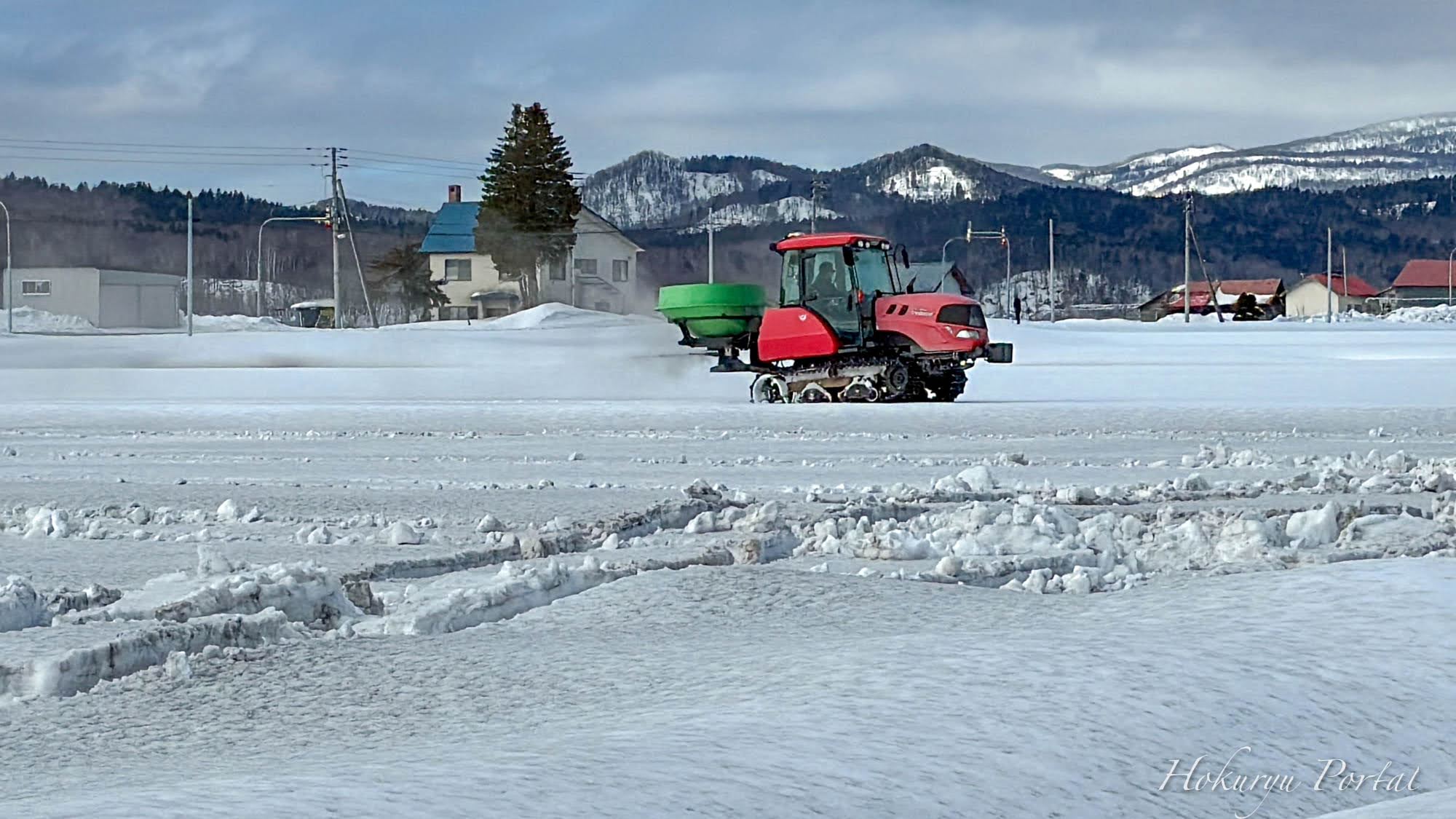
In mid-March, the rice paddies are still covered in thick snow. However, in order to begin spring farming, the snow must be melted as quickly as possible. Snow melting agent is a black, powdery material that, when sprinkled on the surface of the snow, absorbs the sun's heat and melts faster than the surrounding snow.

Driving across a snowfield on a crawler
At the site where the snowmelt agent is being spread, a forklift is first used to load large bags of the agent into the green hopper of a crawler-type tractor. Two heavy bags of the snowmelt agent are lifted and poured into the hopper. In the background, vast rice fields still covered in snow stretch out before you.

Two crawler trucks work in perfect unison, drawing streaks of black de-icing agent across the white snowfield. In the background, the mountain range of Shokanbetsu shines white, and the magnificent landscape of Hokuryu Town unfolds before us.

"We probably can't go up there. Should we put it off for later?" "It's still only 4 or 5 degrees Celsius, so it'll probably take almost 10 days to melt. No, maybe about a week."
The staff members communicate with each other on-site, assessing the snow conditions and proceeding with their work. Here, you can see agriculture practiced in harmony with nature.

Dialogue with nature
"There's still some snow left in that black area over there (where the snowmelt is progressing), so we have no choice but to enter from this side."
We have to consider the snow conditions, how quickly it's melting, and the topography to decide where to start spreading the snow and in what order. This job requires years of experience and intuition, and isn't something you'll find in a manual.
It takes about one to two weeks from the time the snowmelt agent is spread until it melts. We wait for the arrival of spring, in harmony with nature's rhythm.
Dense Seedling Cultivation: A cultivation technique from Hokuryu Town that will shape the future.
What is dense seedling?
The "dense seedling cultivation" method introduced by Mizuho Corporation is a revolutionary technology that innovates conventional rice seedling cultivation.
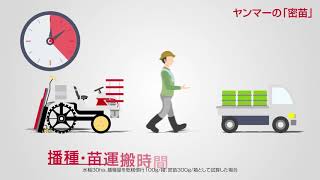
In conventional cultivation (seedling cultivation), the amount of seeds sown per seedling tray is about 120-140g of dry rice, whereas in dense seedling cultivation, approximately twice as many seeds are sown at a high density: 250-300g (about 300-360g of germinated rice).
This technology drastically reduces the number of seedling trays required per 10 ares from the conventional 15-18 trays to about 5-8 trays. This significantly reduces the labor involved in seedling cultivation, greenhouse space, and the costs of soil and materials.
Advantages of dense seedlings
- Dramatic reduction in workload:
The number of seedling trays will be reduced by one-third. The total weight to be transported and the number of repetitions will be drastically reduced, fundamentally solving occupational safety and health issues such as lower back pain and fatigue among employees during the busy spring farming season. - Curbing capital investment:
Reducing the number of seedling trays makes it possible to cultivate approximately three times the amount of seedlings in the existing greenhouse area. This offers a very strong financial benefit, as it eliminates the need to construct new seedling greenhouses. - Improving the efficiency of transplantation work:
The number of times seedlings need to be refilled (seedling trays added) in the rice transplanter is reduced by approximately one-third. In many cases, it becomes possible to complete planting in large 1-hectare fields without any intermediate seedling replenishment, dramatically improving work efficiency.
Dense seedling cultivation of "Nanatsuboshi" rice in Mizuho
Mizuho's main rice variety is "Nanatsuboshi," a representative high-quality rice variety from Hokkaido. Its exquisite balance of stickiness, sweetness, and luster, along with its long-lasting deliciousness even when cooled, has earned it extremely high praise from consumers and the food service industry nationwide. It is a brand of rice that has consistently received the highest "Special A" rating in the Japan Grain Inspection Association's taste rankings for many years.
While "Nanatsuboshi" has excellent cold tolerance, it also has a characteristic where early leaf discoloration (nutrient deficiency) is easily noticeable in extremely dense planting conditions. To address this characteristic, Mizuho has revised the fertilizer design of its seedling growing medium and adopted materials that allow for nutrient effect control specifically for dense seedlings.
Furthermore, to address the disease risks associated with Hokkaido's unique low temperatures and excessive humidity, we achieve the cultivation of healthy, densely packed seedlings without excessive reliance on chemical pesticides by thoroughly monitoring the microclimate (temperature and humidity) inside the greenhouse, meticulously managing physical ventilation, and precisely controlling soil pH.
Investment and effects of introducing dense seedlings
President Komatsu explains:

"I've been doing dense seedling cultivation for five years now, and this is my sixth year doing it seriously. I wonder why more people don't do something this easy (laughs)."
These words reflect a firm sense of accomplishment with the dense seedling technique and a desire for it to become more widespread.
However, transitioning to dense seedling cultivation requires adapting to the local weather conditions and updating equipment such as rice transplanters, seedling trays, and seeders.
"If we were to replace all the equipment, we'd have to buy a whole new set of rice transplanters, trays, and seeders," says President Komatsu. Seedling trays, which cost around 500-600 yen each for potted seedlings, cost only about 300 yen for dense seedling trays. While replacing everything at once would be a significant burden, the long-term business benefits are clear when you consider that you only need one-third the number of trays.
We are very pleased with the yield results. The results are significantly better than conventional farming methods.
Ready Reserve Self-Defense Force Personnel: A New Way of Working that Connects Agriculture and National Defense
What is the Ready Reserve Self-Defense Force System?
Another distinctive initiative of Mizuho Corporation is the employment of "Ready Reserve Self-Defense Force personnel."
The "Ready Reserve Self-Defense Force Personnel" system allows individuals to work as civilians in private companies during normal times, but in times of emergency, they will participate in direct operational missions as part of frontline units alongside active-duty Self-Defense Force personnel. They are required to participate in 30 days of training per year, maintaining a high level of proficiency.
As of the end of fiscal year 2022 (March 31, 2023), the number of Ready Reserve Self-Defense Force personnel was 7,981. Their deployment is limited to the Ground Self-Defense Force only.
The compatibility between agricultural corporations and ready reserve self-defense force personnel
The benefits for agricultural corporations in employing ready reserve self-defense force personnel are surprisingly significant.
- Coincidence of the off-season for farming and the training period:
Most of the training for Ready Reserve Self-Defense Force personnel is concentrated in the winter months, from November to February, which is the off-season for farming. For agricultural corporations in Hokkaido, winter is a time when farm work almost completely stops. By using this off-season for training, it is possible to secure manpower for the busy farming season while also ensuring participation in training. - Economic benefits:
Companies employing these personnel will receive a cooperation bonus from the Ministry of Defense of 42,500 yen per Ready Reserve Self-Defense Force member per year. Employees participating in the training will also receive a training mobilization allowance of 16,000 yen per day (minimum guaranteed amount of 10,400 yen) directly from the Ministry of Defense, significantly reducing the labor costs for companies. - Quality of personnel:
Ready Reserve Self-Defense Force personnel have undergone rigorous training within the Self-Defense Forces and possess excellent physical fitness, discipline, teamwork, and crisis management skills. For agricultural corporations, individuals with these qualities are extremely valuable.
R8 Work Schedule: A Yearly Agricultural Calendar
On the wall of the meeting room was posted the annual work schedule for Reiwa 8 (2026). It was a color-coded list of monthly tasks for four crops: rice, soybeans, buckwheat, and corn.

A Year in the Rice Cultivation Process
- March:De-icing agent application (as covered in this report)
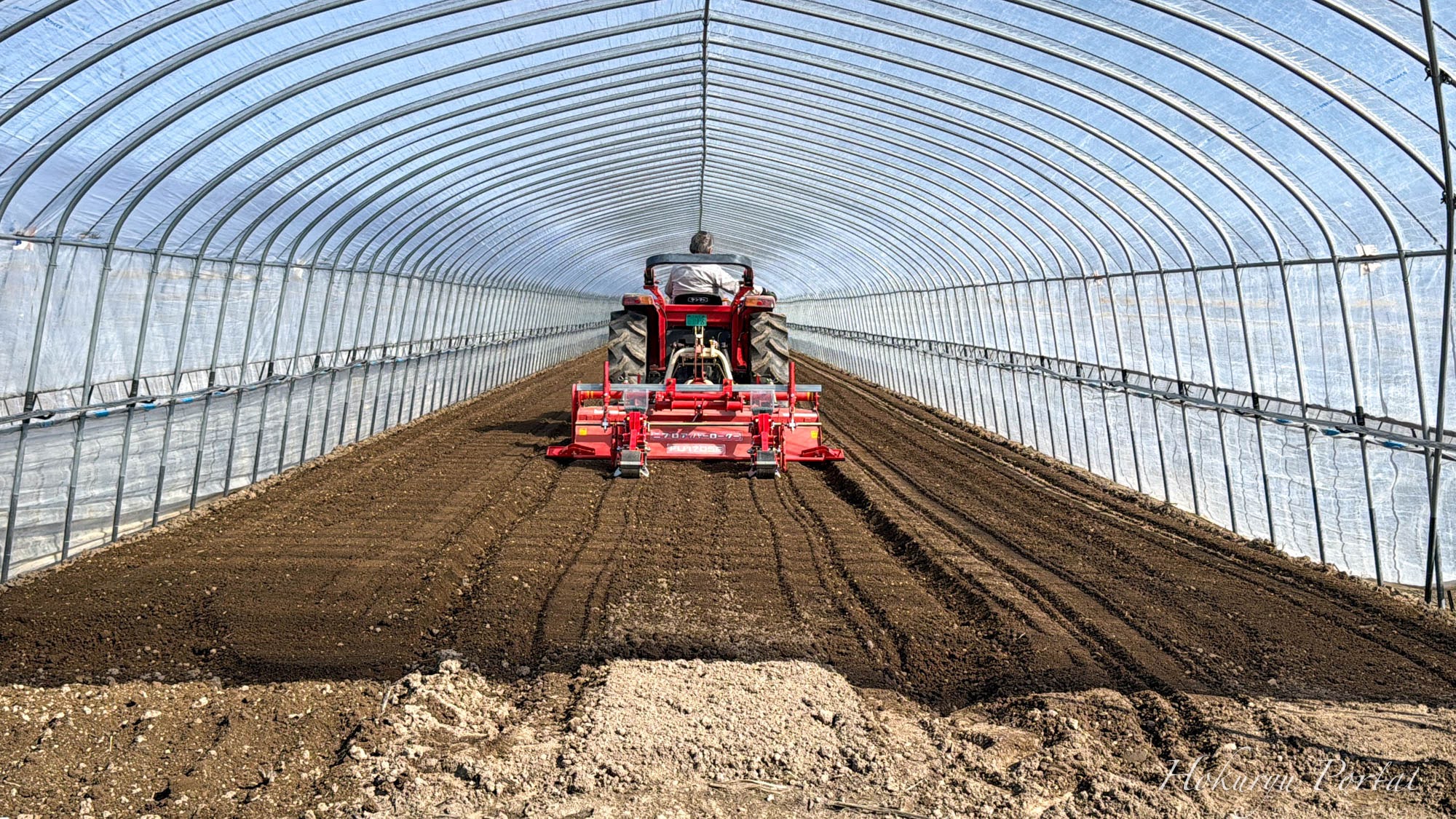
- April:Rotary tillage, base fertilizer application
- Late April to May: Plowing, initial application of pesticides by radio-controlled helicopter, sowing
- May:rice planting
- June:Ditching, mid-season herbicide application by radio-controlled helicopter.
- Late June to July:Droy (drainage management), late-stage agent application by radio-controlled helicopters.
- July to August:Main pest control measures (3 times)
- September to early October:Rice harvesting
From spreading snowmelt agents to harvesting the rice, it's a long journey that lasts about seven months. This time, we've just taken the first step.
The overall picture of multi-product management
It's not just rice. Soybeans are cultivated from late May (disk cutting) to October (harvest), buckwheat from July (sowing) to late August (harvesting), and corn from April (sowing) to early July (harvest). These four crops overlap in their respective seasons, allowing agriculture to be carried out throughout the year.
Because we manage these diverse tasks as a team, our daily morning meetings are absolutely essential.
Dense seedling cultivation management: A fusion of science and experience
Dense seedling cultivation requires more meticulous management than ever before. Sowing 300g of seeds in a single box means that more than 10,000 seeds are competing for space in a confined area.
Three pillars of management
- Thorough temperature and ventilation control:
During the hardening period after germination and greening are complete, it is essential to maintain a lower temperature inside the greenhouse than conventional methods. During the day, frequently roll up the plastic sheeting on the sides of the greenhouse to allow fresh air in and prevent excessive humidity, and avoid extreme heating at night. The goal is to produce stocky, robust seedlings. - Restrictions on irrigation (watering):
Overwatering can lead to weak, elongated growth and poor root mat formation. After watering thoroughly in the morning, it's essential to reduce water by evening until the surface of the potting mix is dry and slightly whitish. Maintaining a clear distinction between wet and dry soil is crucial for developing strong roots. - Soil pH management:
To prevent disease, it is essential to thoroughly disinfect the seeds, and to strictly maintain the pH of the growing medium at a slightly acidic level of around 4.5 to 5.0 to suppress the activity of pathogens.
The fact that these sophisticated management techniques have been widely shared and established among producers on the ground is the main reason why dense seedling cultivation has been widely accepted as a practical technique, unlike past labor-saving technologies (such as milk seedlings).
Mizuho's fields: an overview of approximately 100 hectares.
On the wall of the Life Center, there is an aerial photograph map of all the fields managed by Mizuho Corporation. Divided into three areas, the precise management system, with each field assigned a number, is immediately apparent.
- Area 1Field numbers 1-32, 303-306: Total approximately 32.8 hectares
- Area 2Field numbers 55-150: Total approximately 31.8 hectares
- Area 3Field numbers 169-259: Total approximately 37.3 hectares
The three areas together cover approximately 100 hectares. The majority of the land consists of rice paddies, indicated in blue, while the areas indicated in yellow and orange are for field crops such as soybeans and corn. From today, snowmelt agents have been spread across all of this vast farmland, marking the start of preparations for spring.
The one-year voyage begins.
A red crawler tracks across the vast snowfield, leaving streaks of black de-icing agent. The scene is like the first brushstroke of abundance being applied to a white canvas.
Masami Komatsu, President of Mizuho Corporation, spoke of his "confidence in dense seedling technology" and said that the company is also actively working on a new way of working: "employing ready reserve self-defense force personnel."
Agriculture in Hokuryu Town is more than just rice farming. It involves communicating with nature, challenging new technologies, and working together with diverse individuals. It embodies the "spirit of harmony" that has been passed down through generations in this town.
Over the next year, we will be sharing a complete record of Mizuho Co., Ltd.'s dense seedling cultivation of "Nanatsuboshi" rice, starting with the application of snowmelt agents, followed by seedling cultivation, rice planting, growth management, and finally the autumn harvest.
Next time, we'll be covering the preparations for raising seedlings. Please look forward to it!

YouTube videos
Other photos

Related Sites
◇