Monday, February 3, 2020
The Ladies School Cooking Class (sponsored by the Hokuryu Town Board of Education) was held in the Hokuryu Town Community Center kitchen from 11:00 a.m. on Wednesday, January 29, 2020.
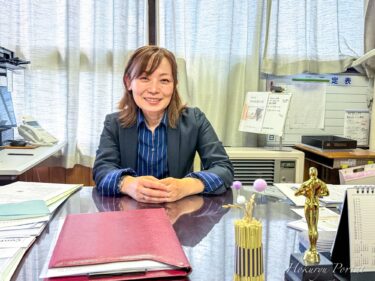
With Kimura Mitsue (nickname: Mi-yan) as the instructor, about 14 people enjoyed a hands-on lesson on "Decorated Sushi Rolls for Setsubun."

- 1 Biography of Mitsue Kimura
- 2 Setsubun Oni Deco Sushi Roll
- 3 Kurosengoku soybean petit karinto
- 4 Sunflower rice and Kurochan Don rice
- 5 Miso soup with pounded yam and cherry tomatoes
- 6 Pickled winter cabbage salad
- 7 Thank you for the meal!
- 8 Introduction of emergency food etc.
- 9 The story of Mitsue Kimura
- 10 Promoting Hokuryu Town on the HBC Radio program "Morning Newspaper Sakurai"!
- 11 Other photos
- 12 Related sites and articles
Biography of Mitsue Kimura

・Representative of the Hokkaido branch of the Japan Deco Sushi Association
・HBC Radio Morning Newspaper Sakurai every Thursday "Food" commentator
・Acquired various qualifications such as Hokkaido Food Meister
・Recipe cooperation from various companies, etc.

The assistants who helped me this time
We were assisted by Terauchi Sayoko (a resident of Rumoi City) who has a first-class certification in decomaki sushi, and Sugiyama Eriko, a nutritionist in the Residents' Affairs Division of Hokuryu Town Hall.
Sayoko Terauchi

Eriko Sugiyama

Setsubun Oni Deco Sushi Roll
Cut the seaweed into three pieces


The sushi rice is red, green, and white.
The red rice is colored with salted haskap. The green rice contains pickled bell peppers and shiso berries, as well as green laver and mayonnaise.
- Use cheese sticks for the eyes, crab sticks for the nose, and thick omelet for the horns.

Weighed in grams
・Precisely measured amounts of sushi rice (40g, 30g, 20g, 15g, 10g, 5g) are wrapped around nori seaweed of each size.
・Combine the whole and involve it


Carefully assemble
I was amazed at how precisely the amount of rice was divided into each part! By carefully and meticulously assembling the parts, a well-defined design was created.


Winding & Cutting


Finishing touch: Adding eyes
・For the final touch, use a nori punch to cut out small ●-shaped pieces of nori, placing them on top as the black part of the paper. The corners are also decorated with small, thin pieces of nori.


Your decorated sushi rolls are ready!


Kurosengoku soybean petit karinto
This is an original recipe that is a favorite of Kimura Mitsue. It's so delicious you won't be able to stop eating it.

Recipe
・Wash the Kurosengoku soybeans and soak them in water overnight.
Drain in a colander, sprinkle lightly with flour, and deep fry in sunflower oil over medium heat for about 40 minutes until crispy.
・In a small pot, boil brown sugar (100g) and water (1 tablespoon) until dissolved, then spread the fried Kurosengoku soybeans on a tray and mix well.
Fry for about 40 minutes at medium heat (we used sunflower oil).


Dissolve the brown sugar

Deep fried Kurosengoku soybeans sprinkled with brown sugar


Kurosengoku soybean petit karinto is ready!

Sunflower rice and Kurochan Don rice
Recipe
・Soak 1 cup of sunflower rice and 1 cup of glutinous rice for 1 hour.
・Carrots (thinly sliced), fresh shiitake mushrooms (thinly sliced), fried tofu (pour boiling water over to remove oil)
・Heat sesame oil in a pot and fry the carrots, shiitake mushrooms and fried tofu.
・Furthermore, add sunflower rice and glutinous rice and stir fry, then add Kurochan Don, dashi stock, cut kelp, salt, soy sauce and sake and bring to a boil. Start with high heat, then reduce to low heat and simmer for 18 minutes, then turn off the heat and let it steam for 15 minutes.
・Finally, add 1 teaspoon of sunflower oil and mix thoroughly.
Heat sesame oil in a pot and fry the carrots, shiitake mushrooms and fried tofu.

Add glutinous rice, sunflower rice, and Kurochan Don and cook.

Sunflower rice and Kurochan Don rice dish is ready!


Miso soup with pounded yam and cherry tomatoes

Recipe
・Halved cherry tomatoes (8 pieces), pounded yam (50g), grilled and cut fried tofu (1 piece), finely chopped green onions
・Add miso to the soup stock, add the ingredients, and cook lightly.
・Sprinkle with green onions and it's done

Pickled winter cabbage salad

Recipe
・Cabbage (1/4 roughly chopped), cucumber (1/2 sliced), carrot (1/5 julienned), shiso leaf (2 julienned leaves)
・Add seasonings (sliced kelp, plum kelp tea, salt) to the ingredients and knead well.
・Finally, add the shiso leaves and drizzle with sunflower oil to finish.
Finish by drizzling sunflower oil over it.

Thank you for the meal!


Introduction of emergency food etc.


The story of Mitsue Kimura
After the class, we spoke with Kimura Mitsue (Miyan).

Mi-yan's relationship with food
Mitsue Kimura, who is originally from Sapporo, was in charge of introducing roadside stations and the cooking corner showcasing creative recipes from local mothers while she was at the NHK Sapporo broadcasting station.
At the time, he realized that there were still many undiscovered Hokkaido dishes, and felt that it would be great to help spread the appeal of food in each region of Hokkaido.
At that time, the "Hokkaido Food Meister" system was established, and he became the first person to obtain the qualification in 2005. After that, he worked hard to obtain qualifications one after another, including vegetable sommelier (2006), grain expert (2006), deco-makizushi meister (2012), and deco-mochi meister (2015).
At that time, she was thinking about opening a shop, and by chance, she ran a cafe at "Banyanoyu" in Ishikari City for 2-3 years, but closed it when the facility closed.She then sold vegetables and demonstrated them at the Ishikari City direct sales store "JA Ishikari Local Market Tore no Sato" (Tarukawa, Ishikari City) for a year.She then continued her activities with the goal of becoming a cooking teacher.
My encounter with Deco Sushi
After discovering deco-makizushi, he is now actively involved in spreading the word about delicious Hokkaido rice and getting local people involved in local specialties. He has been attending food events in Tokyo for the past 10 years, and every year he makes new discoveries about food, one of which was his encounter with deco-makizushi!
At the moment they met, something clicked in Mii-yan's heart, and the next day she set out to obtain qualifications in deco-maki sushi, earning second-class, first-class, and meister qualifications.
"Deco sushi rolls are simply a gateway to getting local people involved, and we will be serving dishes using locally produced ingredients. By entering the area, we hope to be able to involve and connect the people with the local specialty dishes. I think I have visited around 10 areas of Hokkaido so far, and I would like to continue to expand my reach," says Mi-yan.

The food environment in which I grew up
"My father was a hunter, so from a young age I would watch him prepare game meat (venison and duck) right in front of me. Now I can do it myself.
My mother was a great cook, so I clearly remember the first tastes I ever had (celery, rice bowls, handmade soba noodles, etc.).
"My grandfather ran a sweets shop called Kimuraya in Iwamizawa. When I was little, I asked my grandpa, 'Can you make ice cream at home?' He answered that question. I still can't forget the taste of the ice cream he made by taking it out of the fridge, mixing it, putting it back in the fridge, and mixing it again," Mi-yan said with a happy smile.
Thoughts about Hokuryu Town
"I've been paying attention to Kurosengoku ever since it was revived as the 'mysterious tiny black soybean.'
I have known for a long time that Hokuryu is a town of sunflowers. Although it is a small town, I feel that it is a town where you can enjoy beautiful sunflowers.
As I got to know the local people better, I realized it's a wonderful town, with only good people. I also felt a strong desire to promote the sunflowers that have been cultivated in the town for over 30 years.
"As a goodwill ambassador for Hokuryu Town, I intend to continue promoting the charms of Hokuryu Town," said Mi-yan, with delightful words!!!
Mi-yan's favorite food: Genghis Khan!
When asked, "What is your favorite food?", Miiyan immediately replied, "Genghis Khan!!!"
"I've decided that even for my last supper, I'll have Genghis Khan! I eat it once a week! I've even had it three times in one week! When friends come over, I always have Genghis Khan! There are times when I suddenly get the urge to eat Genghis Khan and think it's about time!
When I eat at home, I like seasoned Genghis Khan, but when I eat out, I like raw lamb and other dishes," says Mi-yan with a smile.

Promoting Hokuryu Town on the HBC Radio program "Morning Newspaper Sakurai"!
The next day, on January 30th (Thursday), she promoted Hokuryu Town as a "food commentator" on the HBC radio program "Morning Newspaper Sakurai" (6:30-9:00). Mi-yan appears on "Morning Newspaper Sakurai" every Thursday.
Decorated sushi rolls
"Deco-makizushi" are rolled sushi that come in various shapes, including floral patterns, and can add a fun touch to your dining table. They also spark lively conversation at home parties with friends. As a Meister at the Hokkaido branch of the Japan Deco-zushi Association, I work to promote Hokkaido's local specialties and people.
This time, in preparation for Setsubun, I made a red demon decorated sushi roll, with the demon's face appearing on the cut side of the roll.
The people who gathered were local residents of Hokuryu Town. It was their first time making deco sushi rolls. Some people said they don't make sushi rolls themselves, so they bought them, but when they saw the finished product, smiles spread across their faces.
The process of making this sushi roll involves rolling up the individual parts, assembling them on a sheet of nori seaweed, and then rolling them up. In the case of the red demon, each part, such as the demon's eyes, nose, curly hair, and horns on top of the head, is rolled up, then assembled and rolled up.
The idea is to imagine it as a nori-wrapped version of Kintaro candy, where the more you cut it, the more patterns appear.
While rolling, there is a sense of excitement as you don't know what will happen, whether the pattern will appear on the cut surface, or how the finished product will turn out until you cut it.
When it was finished, the excitement was at its peak. When the cut pattern appeared, cheers of "Wow!" and smiles spread across the room.
The rice grown in Hokuryu Town is called "Sunflower Rice" and there are varieties such as "Oborozuki," "Yumepirika," and "Kitakurin." The variety that is best suited to nori-maki-zushi is "Nanatsuboshi," which has been used to create deco-maki-zushi that "wraps up good fortune."
Sunflower rice and Kurochan Don rice
Hokuryu Town is famous for its "Sunflower Rice" and "Kurosengoku." There is also a recipe using these two: "Sunflower Rice and Kurochan Don Takikomi Gohan."
This is Kurosengoku soybean rice made with the local glutinous rice varieties "Kaze no Ko Mochi" and "Nanatsuboshi." The ingredients are carrots, shiitake mushrooms, and fried tofu, which are fried in sesame oil before being cooked with dashi, seasonings, and Kurosengoku Don. After cooking, sunflower oil is added to give the Kurosengoku soybean rice a glossy finish.
The product cooked together is "Kurochan Don," sold by the Kurosengoku Business Cooperative. This Kurosengoku dongashi is made in the same way as "dongashi," which is made by applying heat and pressure. It can be eaten as is, but you can also add it to rice and cook it to easily make bean rice.
Kurosengoku soybean petit karinto
Another item is "Petit Karinto."
It may look simple, but once you start eating it, the fragrant taste of beans and brown sugar will make you want to stop. This bean karinto is fried in sunflower oil and sprinkled with brown sugar, and the combination of Kurosengoku soybeans and sunflower oil is the best.
Kurosengoku soybeans contain the functional component polyphenols, and sunflower oil is rich in vitamins and minerals, making this a very luxurious dish that is unique to Hokuryu Town.
"By incorporating local specialties and the townspeople, this cooking class has become a celebration of good fortune in the lead-up to Setsubun," said Mi-yan, who gave a strong promotion of Hokuryu Town's specialties.

With her cutely decorated sushi, she connects local specialties with the local people, bringing with her "wonderful fortune," and we send our boundless love, gratitude, and prayers to the adorable smile of Kimura Mitsue, also known as Mi-yan...
Other photos
Related sites and articles
・Hokkaido Food Meister Kimura Mitsue (Miyan) Official Blog
・Japan Deco Sushi Association Official Website
・Morning edition Sakurai | HBC Hokkaido Broadcasting
・(Announcement) Mitsue Kimura's "Deco Sushi Rolls for Setsubun" Ladies' Cooking Class (Hokuryu Town Board of Education)
・Sales fair for Hokuryu Town's special products "Sunflower oil," "Sunflower rice," and "Kurosengoku soybeans" @Mitsui Outlet Park Kitahiroshima(July 1, 2019)
・"Hokkaido Food to Pass On" Video Contest, Awards Ceremony & Networking Event (Hosted by the Hokkaido Agricultural Administration Office, Sapporo City)(March 18, 2019)
◇ Photography and editing: Noboru Terauchi Interview and text: Ikuko Terauchi