Monday, August 21, 2023
On Thursday, August 17th, the 2023 "Keori Buddha Unveiling Ceremony" was solemnly held at Ryusenji Temple (Ryusenji, head priest Teragaki Nobuaki), a Jodo Shinshu Honganji temple in Hokuryu Town.
Approximately 40 parishioners participated in the annual unveiling ceremony for the precious secret Buddhist statue, the Hair-Weaving Buddha (a hanging scroll of a hair-clad Buddha), which is only displayed once a year, chanting the Nembutsu and joining their hands in prayer.
- 1 "Hair-woven Buddha" with hair (black and white) woven into it
- 2 A speech by the 4th head priest, Nobuyoshi Teragaki
- 3 Reiwa 5 "Hair-woven Buddha Scroll Unveiling Ceremony"
- 4 Greetings from Mr. Yoshida Sakae, head of the temple parishioners
- 5 Lecture by Chief Priest Nobuaki Teragaki
- 5.1 The words of Saint Shinran
- 5.2 Words from the head priest, Nobuaki Teragaki
- 5.2.1 Unveiling of the secret Buddhist statue "Kamiori Buddha" that has been kept secret for 95 years
- 5.2.2 Hair, the second most precious thing after life, is woven into the Buddha.
- 5.2.3 The given date is meaningful
- 5.2.4 This world is a filthy land
- 5.2.5 The Pure Land is a pure, conflict-free, and anger-free world.
- 5.2.6 "Namu Amida Butsu" in the world of earthly desires
- 5.2.7 The desire to do good for others "Satisfaction"
- 5.2.8 It's only natural that things won't go well
- 5.2.9 The secret to not getting muddy
- 5.2.10 Awareness
- 5.2.11 Calm your mind by chanting "Namu Amida Butsu"
- 5.2.12 Memorial service means living each day with a smile
- 5.2.13 The importance of finishing on time
- 5.2.14 A life that leaves you feeling sad
- 6 Red rice and manju
- 7 Treasures of Ryusenji Temple: "Peacock and Phoenix" sliding door painting by calligrapher Seiko-e
- 8 YouTube videos
- 9 Other photos
- 10 Related articles and sites
"Hair-woven Buddha" with hair (black and white) woven into it
The "Hair-woven Buddha," which is considered rare even in Hokkaido, is a hanging scroll of the Amida Buddha that was completed in March 1928 at the request of the founding chief priest of Ryusenji Temple, Teragaki Kyoshin, with the aim of expanding the temple's parishioners and spreading the faith.
A group of organizers came together to collect black hair from Hongan sect believers from across the Kita-Sorachi, Naka-Sorachi and Rumoi areas, as well as beards and gray hair from ordinary women, and then specially commissioned a Buddhist altarware specialist store in Kyoto to create this precious fabric.
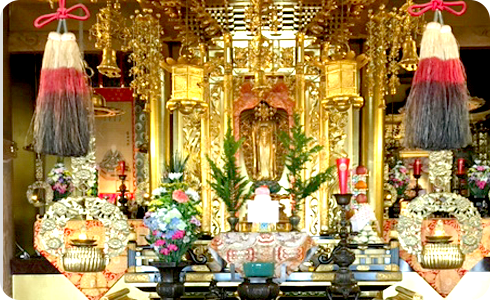
The hair woven Buddha is covered in gold leaf and is made of silk, gold thread, and hair (black and white), with the image of Amida Buddha clearly woven into the halo of 48 strands. The hanging scroll measures 173 cm in length and 69 cm in width.
At the time, it was believed that by weaving one's own hair into the fabric, one would form a sacred bond with the Buddhas and Bodhisattvas and attain the merit of attaining enlightenment in this very body.
Jodo Shinshu Honganji Temple, Hekiunzan "Ryusenji Temple"
On the day before the memorial service, while preparations were underway, we visited Ryusenji Temple, where we were given a special opportunity to see the hair on the lining of the hanging scroll.

Main Hall

Hair-woven Buddha


Hair on the lining of a hanging scroll

A speech by the 4th head priest, Nobuyoshi Teragaki
We spoke with the fourth head priest, Nobuyoshi Teragaki, despite his busy schedule.


"The first chief priest of Ryusenji Temple was originally from Toyama Prefecture and emigrated to Hokkaido, where he founded Ryusenji Temple in 1896. At the time, the land was overgrown with bushes, and I imagine that our ancestors had to cut down the trees and cultivate the land, which must have been a continuous struggle. The land was provided by the Watanabe Farm in what is now Hekisui, and the Ryusenji preaching hall was first established there.
The hanging scroll of the Amida Buddha, "Kamioributsu," was created with the aim of expanding the number of parishioners and encouraging more people to visit the temple. It is a rare hanging scroll, so rare that it is almost non-existent even in Hokkaido. This year marks its 95th year, but it is a precious piece of fabric that is still in almost perfect condition.
In 1928, through the help of several caretakers, women's black and white hair was collected and sent to a Buddhist altar specialty store in Kyoto, where a special order was made for a hanging scroll.
The completed hanging scroll passed inspection at Higashi Honganji, the head temple of the Jodo Shinshu sect, and was delivered to Ryusenji in March 1928. At that time, the completed Hair Buddha was displayed and toured around the towns of those who had donated their hair.
Since then, the "Kamiori Buddha Opening Axis Ceremony" has been held every year on August 17th, and parishioners have been able to visit the temple while viewing the statue. In the past, after worship, theater troupes and actors would come to town and perform plays, rakugo (traditional Japanese folk songs), and other entertainment on a temporary stage set up within the temple grounds, much to the delight and enjoyment of the many townspeople.
When I was a child, I used to look forward to picking up the many coins that had been left lying around the temple grounds the next morning.
Perhaps thanks to the Buddha's blessings, this memorial service has never rained except for one occasion. It did rain only once during my final years as chief priest, but that was at the agricultural cooperative, as it also served as a beer party sponsored by the Young Adults Division to commemorate the Kamiori Buddha Unveiling Axis Memorial Service. I've heard that it hasn't rained in the other 95 years.
The people who donated hair are scattered all over Hokkaido, but some travel from far away to visit the memorial service. Mr. Kameyama Kinbei of Fukagawa City has been the central figure in organizing this. His descendants are happy to visit the memorial service.
"When parishioners donate hair, they come to the temple with the greatest joy, knowing that their own hair has been transformed into the image of Amida Buddha, and the great connection that this creates. The Hair Weaving Buddha Ceremony is a precious memorial service that forges an important bond between parishioners and the temple," said the fourth head priest, Nobuyoshi Teragaki, in a gentle and courteous manner.

Reiwa 5 "Hair-woven Buddha Scroll Unveiling Ceremony"
The 2023 "Hair-Weaving Buddha Scroll Unveiling Ceremony" will begin at 2:00 p.m. on Thursday, August 17th.
The memorial service was conducted by the head priests of three local temples, who solemnly recited sutras. Afterwards, parishioners offered incense and paid their respects to the Hair-Weaving Buddha.


Moderator: Yoshiaki Arima

Head priest on visit to temple
The head priests from the temples Kotoku-ji, Hoko-ji and Seiun-ji in Kitaryū Town came to pay their respects.


To all parishioners

Chief priest Nobuaki Teragaki reciting sutras

Incense burning at the table

Greetings from Mr. Yoshida Sakae, head of the temple parishioners

"I would like to express my gratitude for the 2023 'Hair-Weaving Buddha Unveiling Ceremony.' The 'Hair-Weaving Buddha' was made in 1928, and this year marks its 95th anniversary.
I am an officer of the organization, and thanks to everyone's support, this memorial service has been held for the long 95 years.
Typhoon No. 7 has never crossed Japan before. This time, it has passed through Shikoku, Kyoto, Nara, Tottori, and even Toyama, and is now approaching the coast of Rumoi in the Sea of Japan, as if it had come to pay its respects at our temple's "Kamiori Buddha Memorial Service."
In the past, after this ceremony, we would hold a beer party in the temple grounds. I remember how difficult it was because we were worried about rain.
The temple will hold its Hoonko lecture on August 26th and 27th.
With temperatures exceeding 30°C, the health center has issued a food poisoning warning. Temperatures of 28°C are forecast to continue for about a week. We hope you will take good care of your health and come to visit.
"Thank you very much for coming today," said representative Yoshida Sakae in his greeting.

Lecture by Chief Priest Nobuaki Teragaki
The words of Saint Shinran
"If one encounters the power of the original vow, there is no one who will tickle in vain.
The treasure ocean of merit is overflowing, and the muddy waters of earthly desires are undistinguished.
Namu Amida Butsu, Namu Amida Butsu, Namu Amida Butsu"

Words from the head priest, Nobuaki Teragaki

"Despite the heat and busy schedules, many people from near and far came to visit the Buddhist temple's treasured possession, the Hair-Weaving Buddha, at the Buddhist memorial service for its unveiling.
We are extremely happy and grateful that we were able to hold such a grand memorial service this year with the help of all of you.
I think it is a great honor that Ryusenji Temple is able to hold this memorial service every year in this way, receiving the thoughts of our ancestors and the various thoughts of all of you living in the 21st century.
Unveiling of the secret Buddhist statue "Kamiori Buddha" that has been kept secret for 95 years
As you may know, this "Hair Weaving Buddha" is a "hibutsu" (secret Buddha). The founding chief priest of Ryusenji Temple, Teragaki Kyoshin, came up with the idea for this "Hair Weaving Buddha" in 1928. The hanging scroll was made using the woman's hair and the man's beard at a store specializing in Buddhist altar fittings in Kyoto.
The annual opening of the scroll is held on August 17th every year, and has continued uninterrupted for 95 years since 1928 (Showa 3), bringing with it the souls of those who were present at the time.
I feel the passage of time and keenly realize that we have come to where we are today by overcoming the difficulties of that time.
From the Meiji, Taisho and Showa periods, in an environment without pavement, running water, gas or electricity, they travelled to Hokkaido and settled in Hokuryu, where they built a temple.
At the time, people had few possessions and no money, and were struggling to provide for their families, but they felt a strong desire to do something to help the temple. The head priest came up with the idea of weaving Buddha fabrics using people's hair.
Hair, the second most precious thing after life, is woven into the Buddha.
For women, hair is the second most important thing after life itself. By donating hair, life is woven into the Buddha, and the "Hair Weaving Buddha" is woven with the hope that Ryusenji Temple will continue to prosper as a place for nembutsu prayer.
I think it is very gratifying that the story has been passed down from generation to generation, from your mother, grandmother, and great-grandmother, and that visits to the shrine have continued for nearly 100 years.
The given date is meaningful
There were times when I wished that the memorial service, which was held in the heat of this summer, could be held during a cooler period, or after the rice harvest, but each time of year brings different work to be done.
Dates seem to exist, but they don't. I feel that the dates we are given are given precisely because they have their own significance. Today's memorial service has given me a sense that we are able to continue this memorial service by keeping the thoughts of our ancestors alive, and I have been able to experience this once again.

What I would like to convey through this Hair Woven Buddha is what the "Pure Land" of our ancestors is, woven from the hair and beards of those who had a connection with us at the time.
The "Pure" in Jodo Shinshu means "pure," "free from conflict," and "free from anger and jealousy."
This world is a filthy land
Contrary to the Pure Land, this world is the Impure Land. The Impure Land contains the meaning of "to hate" as in the phrase "Please take care of your body" and "Please take good care of your body."
The word "Edo" means "dirty," "difficult to live in," and "uncomfortable." It also includes the meaning of "things not going as planned."
The word "immortal" means, "This world is a place where things do not go as you wish, so do not harm your heart (do not worry). Be yourself and walk the right path."
People say it's hot now, but it will probably get cooler in two weeks. When November and December arrive, white things start falling and people start saying it's cold. The message is to enjoy the heat when it's hot, and the cold when it's cold, and to make your body feel better.
The Pure Land is a pure, conflict-free, and anger-free world.
The Pure Land is a pure, honest, conflict-free, and hate-free world. Just like Prince Shotoku's words, "Harmony is the most precious thing," it is a world of harmony that is indescribable in words, a world of formlessness that is harmonious and one.
One day, your ancestors will come to welcome you to this pain-free, conflict-free, pure world through a memorial service.
You are about to go to a world without pain or sorrow, where everything is joyful. When I tell you that you want to go there quickly, you all shake your head and say, "I don't want to go yet!" You are all going even if you don't want to. However, you are going because it has been decided that you will go. If you are going to go anyway, wouldn't it be better to go sooner? That is not the case.
"Namu Amida Butsu" in the world of earthly desires
This is the result of our earthly desires, and we don't worry because we want to worry, but because of various connections that cause us to worry.
You are not alone in your life, woven together with the joys of meeting and the sadness of parting. Though invisible to the naked eye, the unmistakable Buddha is always by your side, chanting "Namu Amida Butsu" (Namu Amida Butsu) as he asks you to walk with him on the path to the Pure Land.
The desire to do good for others "Satisfaction"
When you are satisfied, you want to do more for others. When you are dissatisfied, you want more from others.
You are all professionals in life, so I'm sure you can imagine what will happen in your life.
Always act in a way that you want to do more for others than you want them to do for you.
It's only natural that things won't go well
Life is such that we repeatedly do things even though we know we shouldn't.
Humans cannot understand each other while they are alive. People who cannot understand each other are family, friends, coworkers, things that cannot be understood or estimated, and they gather together to live and go about their daily lives.
Therefore, it is natural that things do not go well. By taking things that are going well for granted, we end up complaining, grumbling, and insulting each other. Sometimes gratitude can turn into complaints and grumbling.
The secret to not getting muddy
There is a secret to getting rid of this. It is to be "clear." The "purity" in "Pure Land" means clarity. If you have an honest and clear mind, you will have fewer worries.
When you start complaining, you should think to yourself, "I'm being vague."

Awareness
It's okay if you can't become pure water. When your mind is clouded, just imagine the existence of pure water and become aware of it, and your complaints and anger will subside.
Calm your mind by chanting "Namu Amida Butsu"
This is difficult to put into practice, so the Buddha delivered the nembutsu: "You've got to be kidding me! Haamida Butsu..." "You've got to be kidding me! Haamida Butsu..." "Why me? Namu Amida Butsu..."
I have made it a habit to chant the Nembutsu "Namu Amida Butsu" whenever I have a complaint. This is a concrete example of the Buddha protecting me.
In everyday life, it is good to say things like "Thank you," "It's all thanks to you," and "I was wrong, I'm sorry," but it is when you cannot say these things in the moment that you should chant the Nembutsu "Namu Amida Butsu" in your heart.
When you do this, the anger, complaints, and jealousy won't go away, but they will gradually decrease. Your emotions will calm down, and when you listen carefully, your feelings will change, such as "Oh, so that's what it was," or "I'm sorry I didn't notice."
Memorial service means living each day with a smile
Isn't it the true nature of human beings to want to live in a world where we can understand each other and say, "It's all thanks to you"?
Buddha and ancestors would be pleased to see their descendants living their daily lives with smiles and a sense of gratitude. In Buddhism, this is called "memorial service."
The importance of finishing on time
Finally, I would like to share with you the words of my mentor. They are, "Finish on time," "In fact, finish a little earlier!" and "Don't go over time. Finish when you feel you want to hear a little more. That's just right!"
A life that leaves you feeling sad
The same is true of life. It is not an end, but a "remaining memory." It is not a matter of early, peak, or end, but rather, "Even if you feel sad to leave, when your ties to this world have come to an end and your strength has worn off, you should go to that land" (Tannisho, Chapter 9).
Each and every one of you is destined to enter the Pure Land and become a being of eternal life and eternal light.
I hope that you will continue to chant the Nembutsu, respect each other, help each other, and although things may not always go as planned, I would like to express my sincere gratitude to everyone who attended despite the heat.
Namu Amida Butsu, Namu Amida Butsu, Namu Amida Butsu."

Red rice and manju
The event ended with everyone singing together, worshipping, and chanting the Nembutsu.
On the way back, we were given souvenirs of red rice and manju.

Treasures of Ryusenji Temple: "Peacock and Phoenix" sliding door painting by calligrapher Seiko-e
The paintings on the sliding screens on the left and right of the inner sanctuary of the main hall were created by the calligrapher Seikyou-e, and are said to have been displayed in the Taishokan building run by the temple's founder, Arima Yukichi.
Left sliding door painting "Peacock"

"Phoenix" painting on the right sliding door of the inner sanctuary

The garden is well-maintained within the temple grounds. The handmade lantern in the center was a donation made with great care by parishioner Toshiaki Fujii.

Through hair, the soul becomes one with Amida Buddha, forming a precious bond and accumulating various merits, and we offer our boundless love, gratitude, and prayers to this memorial service for the great and secret Buddha, the "Hair-Weaving Buddha."
YouTube videos
Other photos

Related articles and sites
Please contact Ryusenji Temple for funerals, permanent memorial services, memorial services, and other memorial services in Hokuryu Town, Uryu District, Hokkaido.
▶ Homepage here >>

![[233] Nobuaki Teragaki – Hokuryu Town Portal (Hokkaido) – Japan’s No. 1 Sunflower Village](https://lh4.googleusercontent.com/-5xoGdCjNYgE/VRe8o2YfuII/AAAAAAABuvw/4QbPjVcRtOA/w1296-h864-no/ILCE7M2_%2B737)

◇ Interview and text: Ikuko Terauchi (Photography and editing assistance: Noboru Terauchi)
![The Sunflower Festival, which was held from July 22nd to August 20th, has now ended 🌻 Thank you to all our customers who came 😊 [Himawari Restaurant]](https://portal.hokuryu.info/wp/wp-content/uploads/2023/08/2023-08-22-7.52.16-375x224.jpg)