Monday, February 21, 2022
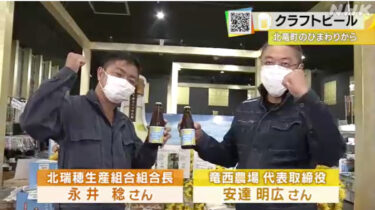
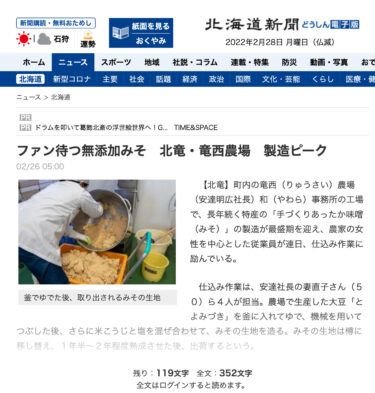
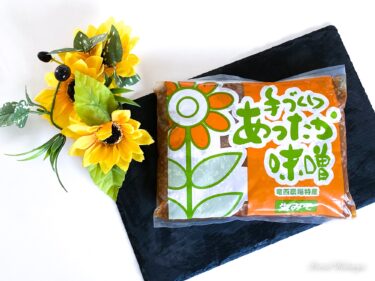
Ryusei Farm Co., Ltd. (CEO: Akihiro Adachi) produces "Homemade Warm Miso" using rice and soybeans grown on Ryusei Farm. We spent four days covering the miso-making process.
"Homemade Warm Miso" has been produced by the Ryusei Farm Agricultural Cooperative since around 1975. Even after it was transferred to Ryusei Farm Co., Ltd., the production method was continued and has been improved upon to the present day.
- 1 Ryusei Farm Co., Ltd. Japanese Office & Miso Factory
- 2 Working members
- 3 Ingredients (no artificial seasonings added): soybeans (produced in Hokuryu, not genetically modified), rice (produced in Hokuryu), salt
- 4 The taste of warm handmade miso
- 5 Steps for making miso
- 5.1 1. Steam the rice that has been soaked in water overnight and drained.
- 5.2 2. Leave the steamed rice for about 10 minutes, then cool it to about 40℃ (42-43℃) and sprinkle the koji mold (seed cutter).
- 5.3 3. Place the rice mixed with the koji starter in a wooden box, cover with a cloth, and place in a warmer to heat and ferment.
- 5.4 4. Ferment while carefully controlling the temperature (keep warm for 48 hours)
- 5.5 5. Turning the rice koji (flour kneading)
- 5.6 6. Dekoji (Miso koji)
- 5.7 7. Draining salt
- 5.8 8. Soak the soybeans overnight, drain, and boil or steam (alternate between boiling in a pot and steaming).
- 5.9 9. The boiled soybeans are mashed using a machine
- 5.10 10. Roll the mashed soybeans into balls, make a depression in the center (like a red blood cell or donut), and cool to about 40°C.
- 5.11 11. Miso preparation
- 5.12 12. The miso stored in the barrel is left to age for about one and a half to two years.
- 6 Members' impressions
- 7 "Homemade warm miso" is sold within Hokuryu Town
- 8 Other photos
- 9 Related articles
- 10 Ryusei Farm Co., Ltd.
Ryusei Farm Co., Ltd. Japanese Office & Miso Factory
The factory where miso is currently made was newly built seven years ago.

Working members
The working members are Naoko Adachi, Mihoko Nagai, Miki Akamatsu, and Miyuki Takahashi, and are mainly made up of farming mothers.
Ingredients (no artificial seasonings added): soybeans (produced in Hokuryu, not genetically modified), rice (produced in Hokuryu), salt
The ingredients are rice from Ryusei Farm (a blend of Nanatsuboshi and Yukisayaka rice) and soybeans from Ryusei Farm (non-genetically modified), koji mold (seed koji) sourced from Akita Konno Shoten (Daisen City, Akita Prefecture), and regular salt.
Steamed rice is mixed with koji mold to make rice koji, and then boiled soybeans, salt, and rice koji are mixed together to make miso, which is then left to mature for about one and a half to two years.
Hokuryu Town-grown rice "Yukisayaka"

Hokuryu Town soybeans

Diamond Salt Regular Salt

The taste of warm handmade miso
Most miso in Hokkaido has a koji to soy ratio of 1:1, but "Homemade Warm Miso" has a koji to soy ratio of 0.7:1. Because the koji ratio is relatively low, the miso is less sweet and has a stronger saltiness. If anything, it is said to have a taste closer to the regular miso of Honshu.

Steps for making miso
Miso is made about three times a year, with about 400 kg of "homemade warm miso" produced each time. This was the last batch of miso for the season.
1. Steam the rice that has been soaked in water overnight and drained.
- Steam in a steamer for about 30 minutes after steam rises (99 kg rice: 4.5 kg x 22 bags)


2. Leave the steamed rice for about 10 minutes, then cool it to about 40℃ (42-43℃) and sprinkle the koji mold (seed cutter).
- Mix koji mold and potato starch in a ratio of about 1:7.5 and shake. The potato starch is added to increase the fermentation rate (2g of koji mold is added to 22kg of rice).


3. Place the rice mixed with the koji starter in a wooden box, cover with a cloth, and place in a warmer to heat and ferment.
- The warmer holds 90 kg of rice koji and is filled with hot water to maintain humidity. Temperature and humidity are important for maturation. A seedling incubator is used as the warmer.


4. Ferment while carefully controlling the temperature (keep warm for 48 hours)

- Keep warm at 35°C (30°C to 40°C is the optimal temperature for breeding)
- Koji mold becomes inactive below 15°C, and will self-destruct if it heats up and exceeds 50°C.
- Koji mold reproduces while breathing, and generates heat and carbon dioxide gas during breathing.
- If the air is not exchanged properly, the bacteria will not be able to reproduce due to lack of oxygen, so frequent temperature adjustment is necessary.
5. Turning the rice koji (flour kneading)
- The next day, mix the rice to allow the koji mold to ferment.


6. Dekoji (Miso koji)
- After aging is complete, the rice is transferred to a large wooden box and loosened to release heat (koji brewing).


- The koji is in a good state of fermentation when fluffy white flowers appear around the rice.
- Koji contains many enzymes
The difference between "koji" and "koji": "koji" is a Japanese character created in Japan. The kanji comes from the appearance of Aspergillus oryzae growing on rice like a flower. "koji" is a kanji that comes from China. It is made by steaming grains and allowing Aspergillus oryzae to grow. (Quoted from Marukome)

7. Draining salt
- Mix salt (6 kg) and koji (8.5 kg). By mixing salt, fermentation stops and the temperature does not rise, so it can be stored as is for a day and can be worked on the next day.

8. Soak the soybeans overnight, drain, and boil or steam (alternate between boiling in a pot and steaming).
- Total amount of soybeans this time: 4 kg x 30 bags
Wash the bag in running water and soak it overnight. - Boil 24 kg of soybeans (6 bags of 4 kg each) in one pot for about 30 minutes.


9. The boiled soybeans are mashed using a machine

10. Roll the mashed soybeans into balls, make a depression in the center (like a red blood cell or donut), and cool to about 40°C.
- Make a depression in the center to allow the soybeans to cool more easily


11. Miso preparation
- Mixing rice koji, boiled soybeans, and salt
- Mix all ingredients (rice koji, boiled soybeans, salt) in a mixer.


12. The miso stored in the barrel is left to age for about one and a half to two years.

Members' impressions
Naoko Adachi has been making miso for 21 years, making improvements over the years. Mihoko Nagai, Miyuki Takahashi, and Miki Akamatsu, who have been involved in the project as members, have been doing so for 10 years.

- "Since I started making miso here, I've started making it at home. When I give it to people around me, they're very happy. Making miso has been a great experience," says Nagai.
- "I often give it as a gift to my mother back home, and she is delighted, saying, 'It tastes like the miso of the past, it brings back memories,'" says Takahashi.
- "I came to observe the miso-making process and when I tasted the miso, I realized that it was exactly the flavor I liked, so I wanted to continue making it.
I have been making miso for many years, inheriting the tradition from my predecessor, and I am always impressed by the efficiency of the work process, particularly the procedures and arrangement of tools.
I also participate in various training sessions at the Food Processing Research Center and other institutions, and use what I learn to change my work methods and improve through trial and error.
Above all, I am really happy that there are people who enjoy eating it," said Adachi.

"Homemade warm miso" is sold within Hokuryu Town
"Homemade Warm Miso" is sold at the Sunflower Park Hokuryu Onsen Shop and Hokuryu Town's commercial revitalization facility "COCOWA."
Sunflower Park Hokuryu Onsen
- 163-2 Itaya, Hokuryu-cho, Uryu-gun, Hokkaido Tel: 0164-34-3321 (Map here >>)


Hokuryu Town Commercial Revitalization Facility COCOWA
- Hokkaido Uryu-gun Hokuryu-cho Azawa 6-banchi 6 Tel: 0164-34-4111 (Map here >>)


"Homemade Warm Miso" is a precious miso handed down from Hokuryu Town, made from rice and soybeans grown at Ryusei Farm in Hokuryu Town and rice koji made using a homemade method.
With boundless love, gratitude and prayers, we offer Ryusei Farm's "Handmade Warm Miso," which is grown in the great outdoors of Hokuryu Town and bathed in plenty of solar energy.

Other photos

Related articles

◇ Photography and editing: Noboru Terauchi Interview and text: Ikuko Terauchi
Ryusei Farm Co., Ltd.
[Wa Office] 23-18 Wa, Hokuryu-cho, Uryu-gun, Hokkaido
Tel: 0164-34-2837 Fax: 0164-34-5872
[Production and sales] Rice, miscellaneous grains, and other vegetables
[Manufacturer/Seller] Miso and Koji
[email] ryusai.farm◇gj8.so-net.ne.jp (please replace ◇ with @)