Monday, March 10, 2025
This year, we plan to cover the annual work that goes into growing watermelons at the Hokuryu Sunflower Watermelon Producers Association, right up to shipping them.
As the first step, seeding work for raising seedlings will begin at the end of February. On Saturday, March 8th, grafting work began at Sugimoto Katsuhiro Farm, so we took the time to talk to him during his busy schedule.

- 1 Katsuhiro Sugimoto
- 2 Sunflower watermelon grafting
- 3 YouTube videos
- 4 Other photos
- 5 Related articles
Katsuhiro Sugimoto
Katsuhiro Sugimoto (67 years old) was born and raised in Hokuryu Town. He has inherited farming from generations ago and is a veteran producer with over 40 years of experience cultivating sunflower watermelons.
Sugimoto continues to faithfully preserve the agricultural practices passed down from his great-grandfather's time, exploring and discovering his own unique methods while practicing farming and learning every day.

Sunflower watermelon grafting
Over 1,000 seedlings
"The watermelon seedlings, both rootstocks and scion, are being raised at the JA Kitasorachi Uryu Branch seedling facility. The seedlings, which were sown on February 21st, were received on March 6th.
The total number of seedlings will be about 1,240 (a few more will be grown, including dead seedlings). They are scheduled to be planted around May 5th, 40 days after sowing. The date will depend on the weather and the growth of the seedlings, so we will adjust it accordingly," says Sugimoto.

Purpose of grafting
The purpose of grafting is to prevent problems caused by continuous cropping and to promote growth by cultivating seedlings that are resistant to soil diseases and pests.
Grafting by nomitsugi
The new shoots of the rootstock gourd are removed and then grafted using the "yobi-tsugi" method.


For the rootstock, cut the stem diagonally from top to bottom, and for the scion, cut the stem diagonally from bottom to top, and then align the cut ends. Secure with a clip and plant in a pot.
"After securing it with clips, after 10 days, cut the roots of the watermelon. The bottle gourd will absorb nutrients and the watermelon will grow.
"In the past, when we were sprouting the seeds ourselves, we often had trouble handling them properly, such as cutting the stems the wrong way or fastening the clips too loosely. We try out various methods and choose the one that will help them grow best," explains Sugimoto.

Make a cut from bottom to top on the sunflower watermelon seedling (scion)

Make a cut from top to bottom on the bottle gourd (rootstock)

Combine

Combined state

Crimping with grafting clips

A spirit of trial and error
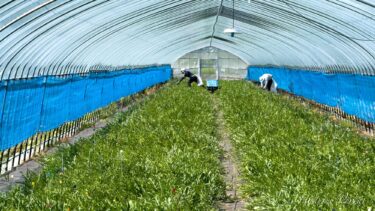
"All cultivation work is carried out according to the weather of the year. Until the plants take root, they are shaded by covering the greenhouse with a tunnel, and once they have taken root, they are exposed to sunlight from time to time to allow them to get used to it.
Before planting, the seedlings are kept at a low temperature until the very last moment, so that they can grow strong enough to withstand any natural environment when they reach the fields. We lovingly train and nurture the seedlings so that they do not grow up weak and unable to adapt to the environment.
Thinking about how to grow the seedlings as if they were my own children, I spend every day trying to adjust the temperature and humidity while facing the weather. I keep the temperature high and adjust the humidity by opening and closing plastic tents to let the humidity out.
Before planting, reduce the amount of water to the minimum.
Three days before planting, refrain from watering the seedlings to make them thirsty and endure as much as possible. If you give them enough water when they are planted in the field, they will be happy, lively, and healthy.
Every year, we constantly compare our cultivation methods with those of neighboring fields, looking for problems in terms of good cultivation methods and poor cultivation practices, and we go through a process of trial and error to find the problems. We watch over the growth of the watermelons, facing them closely and cultivating them with care and sincerity.
Moisture control is important even after planting
For example, when the temperature inside the greenhouse rises due to the heat of the sun on a fine day after planting, the difference between seedlings that wilt and those that remain healthy is due to the moisture content of the soil.
If the soil is given too much water, the roots will grow shallow and horizontally. On the other hand, if the soil is given less water and the environment is somewhat dry, the roots will grow deep underground in search of moisture.
Seedlings with shallow roots that grow horizontally will quickly wilt when the surface temperature gets too high, but seedlings with deep roots will continue to grow healthily and vigorously because the temperature deep underground is not as high.
The weather is different every year, and even within the same site, the condition of the land varies slightly depending on the building, so it is really necessary to adapt cultivation to the location and climate," said Sugimoto, speaking passionately about watermelon cultivation, which involves constant learning all year round and is a serious challenge every day.

Past posters of the Hokuryu Sunflower Watermelon Growers Association
On my way out, I took a look inside the garage. Past posters of the Hokuryu Sunflower and Watermelon Growers Association were lined up on the wall.
I was moved by the poster featuring the faces of all the producers who have supported the activities of the Hokuryu Sunflower and Watermelon Producers Association, which celebrated its 40th anniversary last year!


Furthermore, the number of boxes shipped each year over the years is engraved on the wall panel, giving a real sense of the history of sweat, tears and hard work that has gone into making it a truly moving experience!


Sugimoto never spoils the seedlings, and takes into consideration the environmental conditions they need to grow strong and healthy, carefully watching over their growth and working diligently and lovingly every day to cultivate them.
With his wife Ikuko, who has a cute smile!

We sincerely hope that the watermelon seedlings will continue to grow healthily in the future.
YouTube videos
Other photos

Related articles

◇ Interview and text: Ikuko Terauchi (photography and editing assistance: Noboru Terauchi)