Wednesday, July 10, 2024
Starting just after 10:00 on Monday, July 8th, 10 fifth graders from Hokuryu Town's Shinryu Elementary School (Principal Kamata Sadao) observed the growth of rice at Takada Co., Ltd.'s farm in Mitani, Hokuryu Town.
- 1 Rice planting and growth observation
- 2 YouTube videos
- 3 Other photos
- 4 Related articles
Rice planting and growth observation


We were visited by Jun Kitajima, section chief of the Sorachi Agricultural Improvement and Extension Center, as well as extension staff Keisuke Kurashita and Shuta Hayama.

Jun Kitajima, Section Chief (Sorachi Agricultural Improvement and Extension Center)
On this day, we received an explanation from Jun Kitajima, section chief of the Sorachi Agricultural Improvement and Extension Center.

"Hokuryu Town is a region where rice is grown vigorously. Hokuryu Town is located in the Kita Sorachi region of the Sorachi District. The Kita Sorachi region is the area in the Sorachi District where the most rice is grown.
Hokuryu Town is a leading rice-producing region
There are areas in Minami Sorachi such as Iwamizawa and Kuriyama that are actively producing rice. The towns of Hokuryu, Uryu, Chishibetsu, and Numata are also areas that are working hard to produce rice.
Thirty or forty years ago, rice gradually began to become a surplus, and the government instructed people to grow things other than rice in their rice fields, so they started growing buckwheat, soybeans, and wheat in their rice fields.
In Hokuryu Town, the percentage of people who grow anything other than rice is low, and most of the rice fields are used to grow rice. It is a very valuable region.
Looking around this town, you may notice that there are many rice fields, and more than 90% of them are used for growing rice.
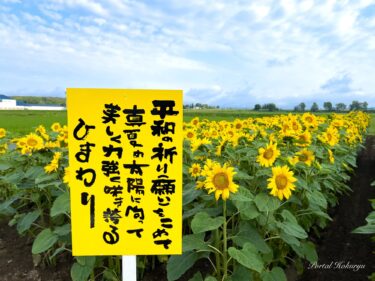
Hokuryu Town calls its rice "Sunflower Rice."
This is something you don't see very often elsewhere. Farmers work together to create rules and follow those rules to grow safe rice.
"Is there anyone whose family is a farmer? Who grows rice?"
(A student raises his hand and says "Yes.")
Your parents are also working hard to produce delicious, safe rice. Please say "thank you for your hard work" to your parents when they come home tired after working hard all day.
Many hardships have led to the present
In today's presentation, there is a graph showing the areas in Hokkaido where rice is grown. Sorachi produces 46% of the rice grown in Hokkaido, which is almost half.
It tells the history of when rice began to be grown. There are stone monuments marking the birthplace of rice cultivation in Hokkaido, such as Eniwa Town and Hakodate City, where rice was first grown in Hokkaido.
There are many stone monuments related to rice in each town, marking areas where active efforts were made to make rice cultivation possible, and areas where rice cultivation first began. When walking around town, try to pay attention to these stone monuments and observe them.
Rice cultivation began at the beginning of the Taisho era. The areas around the Ishikari River and Uryu River used to be hit by floods four or five times a year, and the land around here was often submerged.
Despite these many hardships, rice was cultivated, and gradually research began into methods of preventing and resolving flood damage.
The efforts of the local people have led to the rice production we have today. The rice fields we have today are the result of the efforts of many people and the enormous amount of money they have spent to produce rice.
The document includes a graph showing how much rice has been grown and on what area since then.
The average rice cultivation area in Hokuryu Town is 15 to 50 hectares.
The graph below shows how rice quality has improved over time, with the average area of land used for rice cultivation per household in Hokkaido. Hokuryu Town has an average of 30-50 hectares of land used for rice cultivation, with an average of over 15 hectares.
Increasing the size of rice fields is one way of making efforts to create more rice fields with a small number of farmers.
I hope that everyone will take the opportunity to research at a library or other location and get a real feel for the efforts that have gone into growing rice in Hokuryu Town.

One year of work growing rice
Page 3 of the document is a timeline of rice farming work and paddy rice cultivation over the course of a year.
- March:The snow melts and the work begins
- April:There are many different tasks involved, from sowing seeds, cultivating the rice paddies, adding water, and planting the rice.
- May:The seedlings are grown. Nowadays, this is done with agricultural machinery, but in the days of our grandparents, it was done by hand.
- As an event to thank the people for their hard work in rice planting, people gathered together to celebrate the harvest and give thanks for the harvest.
- July:This is the period when young panicles are formed and the panicles are formed.
This is a very important time, and if it gets too cold during this time, it can be difficult for the rice to produce ears of rice. Water is added to the rice paddies to help alleviate the cold. If the water is left in the paddies for too long, the roots will lack oxygen and rot. Water is added and removed to keep the roots healthy.
From the outside, it may look like they're not doing anything to the rice, but the farmers are carefully observing how the rice grows in places that are not visible to the naked eye, and are constantly caring for the rice by managing the water and mowing the grass on a daily basis.
- From the end of this monthAround early AugustGreen ears start to appear from the stalks. At first they grow straight up, but as the kernels fill up, they turn brown and start to droop.
- September:It will be a harvest
Please continue to observe not only the scenery of the rice fields but also the growth of the rice.
If you have any questions about rice in your school classes, please ask your teacher. You can also ask questions to farmers and us and get answers.
"This is a rare opportunity, so I think it will be a good chance to learn about how rice is grown, the source of the rice that ends up on your dinner table. I think it will be a learning experience that will raise your awareness, so please do your best," said Kitajima.
Observing rice in the rice fields
Observing young ears: taking photos with an iPad
- straw:The hollow parts at the nodes of the stem are called "straws" (they grow in nodes like bamboo)
- Young panicle:Remove the stem and observe the young spike at the base of the stem.
- Flag leaf:The leaf at the top of the stem is the flag leaf, and the young panicle develops within the leaf sheath of the flag leaf, eventually leading to ear emergence.

Water management: Deep or shallow water management according to the rice growth conditions
"We water the rice to protect the ears of rice from the cold," says Akimitsu Takada, chairman of Takada Co., Ltd.
Drone flight spraying of herbicides and pesticides
After planting, we use drones to spray herbicides and also to control pests. The drones fly 3m above the ground to control rice leaf beetles, which eat the leaves.
The next rice observation will be around the end of Obon.
The next rice observation will be around the time of the Obon holiday. By the time the scarecrows are set up, the rice will have ripened and the ears will be drooping.
This concludes our meeting with the Sorachi Agricultural Improvement and Extension Center.
"Everyone, please continue to study rice. Thank you for your hard work today!" said Kitajima.
The students expressed their gratitude in a loud voice, "Thank you very much!", and saw off the staff from the Sorachi Agricultural Improvement and Extension Center.
Q&A with Takada
Q: About the climate
"There was a lack of sunlight in June, and temperatures were rather low. The lowest temperature in June was 8 degrees. Rice growth is three to four days behind average."
Q. About pest control tools
"We use unmanned helicopters and drones for pest control. They are run by two licensed people. One person is at the turnaround point to guide the drone, and the other operates it. The drones are equipped with GPS, so they can be piloted automatically."
Drone observation
In response to the question, "How big is the drone?", he brought out the drone he actually uses and showed it to us.
- The drones used are small Japanese-made models.
- We were shown the drones that were actually being used and observed their shape, size, and weight.

The students actually held the drone and checked its weight. They easily picked it up and exclaimed, "It's lighter than I thought!"

When asked about the differences between drones and helicopters, Takada said, "There are differences in the amount of pesticide they can carry and the speed at which they spray. Helicopters have a larger payload and spray time is shorter."
"Rice farming methods are becoming more labor-saving, so I think that by the time you all become adults, rice farming methods will have evolved and changed considerably. In the future, when we expand our fields, we are considering using drones to sow seeds," says Takada.
Sunflower watermelon tasting
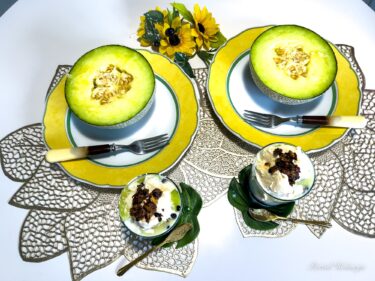
After the observation, Mr. Takada gave us a gift of sunflower watermelon, which we all enjoyed.


As they stuffed their mouths with the delicious sunflower watermelon, the students exclaimed with big smiles and great satisfaction, "It's delicious!"
All the students exchanged words of thanks, saying "Thank you for the meal" and "Thank you very much!!!", and then boarded the bus to head to school.

We hope that the rice plants planted by the students will grow healthily, absorb plenty of nutrients, and turn golden in the fall, becoming the most delicious rice. We offer our boundless love, gratitude, and prayers to these precious ears of rice...
YouTube videos
Other photos

Related articles

◇ Interview and text: Ikuko Terauchi (Photography and editing assistance: Noboru Terauchi)