Monday, December 19, 2022
On a snowy Sunday, December 18th, a straw craft workshop called "Shimenawa Making Experience" was held at Hokuryu Town's commercial revitalization facility COCOWA, sponsored by Hokuryu Town's straw craft group "Nakura" (representative: Katsura Tanimoto).
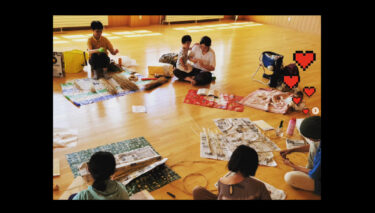
Approximately 30 people from Hokuryu Town, as well as neighboring towns and cities such as Fukagawa City, Imoseushi Town, and Numata Town participated. People of all ages, from children to adults, enjoyed the straw crafting experience in a friendly atmosphere.

- 1 Experience making shimenawa using rice straw
- 2 "Shimenawa" and "New Year's decoration wreath" making experience
- 2.1 Shimenawa Making Group/Instructor: Abe Kunimitsu
- 2.2 Leeds Production Group Instructor: Kaori Asano
- 2.2.1 The straw bundle is divided into three and twisted together.
- 2.2.2 As if nestled against the spiral of the rope's mesh...
- 2.2.3 Bring the ends of the rolls together to make a ring...
- 2.2.4 Cut off any excess straw and arrange the whole piece neatly.
- 2.2.5 Choose your favorite decoration...
- 2.2.6 With various decorations...
- 2.2.7 While gluing with a glue gun...
- 2.2.8 Decorate with various things such as ears of rice and colorful mizuhiki...
- 2.2.9 With lots of lovely decorations...
- 2.3 Impressions from participants
- 2.4 Commemorative photo with the artwork
- 3 YouTube videos
- 4 Other photos
- 5 Related articles and sites
Experience making shimenawa using rice straw
Shimenawa, a New Year's decoration, is a sacred ornament used to welcome the New Year deity.
The shimenawa at Ise Grand Shrine is made from hemp, and at Izumo Taisha Shrine it is made from wild rice, a grass family plant, but in Hokuryu Town, the shimenawa are made from rice straw.

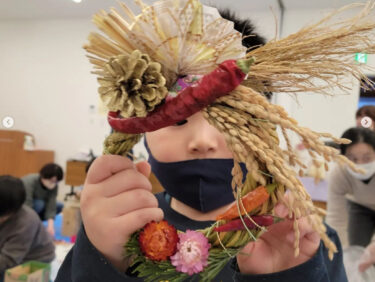
Rice straw from Hokuryu Town, a cute material for wreaths
This is an experience where you can make a "Shimenawa" (sacred rope) and a "New Year's decoration wreath" using straw from local farmers in Hokuryu Town.

Cute materials for New Year's decoration wreaths
The materials used include rice straw, and the materials used for decorations include ears of rice, fir twigs, pine cones (boiled, dried and colored), pine leaves, mizuhiki cord, Japanese ribbons, senryo (traditional Japanese paper), cotton flowers, shishito peppers, dried flowers, and more. There is a wide variety to choose from! You can freely choose your favorite decorations!


"Shimenawa" and "New Year's decoration wreath" making experience
The participants were divided into two groups, with Abe Kunimitsu in charge of making the shimenawa and Asano Kaori in charge of making the New Year's decorations, and the event was held in two parts, from 13:30 and 15:00.
Shimenawa Making Group/Instructor: Abe Kunimitsu
"Shimenawa is a sacred decoration used to welcome the gods, so before you begin, you put your hands together and straighten your posture.
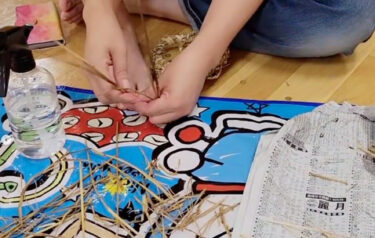
"First, twist the straw by kneading it with both hands. Then twist the straw clockwise, then cross the twisted strings and twist counterclockwise," says Abe.

The "principle of not unraveling" due to the twisting of Shimenawa
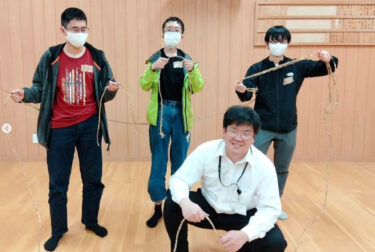
First, let's check the principle behind the twisting of the shimenawa using a towel. When each rope is twisted clockwise and then twisted counterclockwise, the twisting action creates a repulsive force that keeps the twisted rope from coming undone.

While holding it between your legs
The straw is held between the feet and kneaded with both hands to twist it.

Repeated twisting and twisting
The ropes are woven together by repeatedly twisting and twisting...

Attach paper streamers to the shimenawa...
Shidare, which means "sacred" and "purity," is attached to shimenawa to represent a "sacred place."

Leeds Production Group Instructor: Kaori Asano
"First, spray water on the straw to moisten it. Then, wrap each bundle of straw clockwise and tighten it up.
The third twisted strand is placed close to the spiral of the main rope's mesh, and then fitted in and woven together. Once wrapped, it is tightened with a string and the two ends are joined together to make a loop.
"Feel free to choose your favorite decorations and attach them with wire or a glue gun," explains Asano, carefully instructing the students.

The straw bundle is divided into three and twisted together.


As if nestled against the spiral of the rope's mesh...

Bring the ends of the rolls together to make a ring...

Cut off any excess straw and arrange the whole piece neatly.

Choose your favorite decoration...

With various decorations...

While gluing with a glue gun...

Decorate with various things such as ears of rice and colorful mizuhiki...

With lots of lovely decorations...


Impressions from participants
- It was my first experience and it was so much fun!
- It was a valuable experience to touch straw.
- It's surprisingly difficult to decorate a wreath, but choosing the decorations is fun!
- I was glad to be able to understand the direction and meaning of weaving shimenawa.
Commemorative photo with the artwork
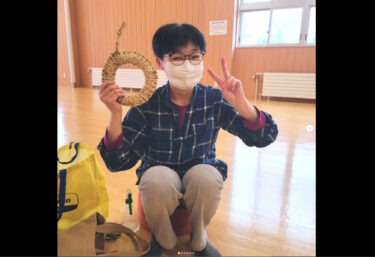
Everyone was smiling and posing with their wonderful finished products!!!

Sacred shimenawa and wreaths made from local rice straw!!!
A happy time filled with smiles, bright and fun energy♡
With boundless love, gratitude, and prayers, we are holding a Shimenawa & Wreath Making workshop where adults and children can all come together and share the joy and excitement of making things...


YouTube videos
Other photos

Related articles and sites
◇ Photography and editing: Noboru Terauchi Interview and text: Ikuko Terauchi
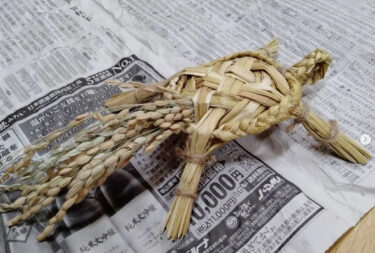
![Today (12/17) is Nakura activity day 🌾 One of our members made a pair of glasses-shaped shimenawa ropes 👓️ They're so beautiful 👏 [Nakura Straw Crafts]](https://portal.hokuryu.info/wp/wp-content/uploads/2022/12/2022-12-18-12.04.03-375x249.jpg)