Wednesday, October 5, 2022
Ryoji Kikura (83), former representative director and chairman of JA Kitasorachi, was asked by Noboru Shimizu, who lives in Chiba Prefecture, to cultivate Makomodake (Makomo bamboo shoots) for the first time in early May this year.
Noboru Shimizu (84 years old) is the son of a farmer in Ebeotsu-cho (now Ebeotsu-cho, Takikawa City). He has known Kikura for many years through his youth group activities.
Mr. Noboru Shimizu

Noboru Shimizu (June 25, 2019)
Shimizu-san moved to Tokyo,Japan Youth Center General Incorporated Foundation(Japan Youth Association Hall).Taro Okamoto Foundation for Contemporary Art・Served as Secretary General
Currently, Shimizu is living in Ichihara City, Chiba Prefecture.Higashi Ichihara Eco Museum, a non-profit organizationHe is a member of the association and is involved in civic activities.
Makomodake bamboo grown using natural farming methods by Ryoji Kikura
In May of this year, the Makomodake seedlings were delivered to Ryoji Kikura, who cultivated the Makomodake in a newly opened field using natural farming methods without the use of pesticides or fertilizers.
The Makomodake plants have grown beautifully using natural farming methods. The seedlings were planted at intervals of 1.0m to 1.5m, and weeding and water management were carried out with great care and dedication. Within a month, the plants began to branch and the stems began to grow, and now, five months later, the plants have grown to a height of about 2m.
The skin at the base of the wild rice plant is peeled off to extract the soft white part known as makomodake. It is juicy, slightly sweet, and soft, and can be eaten raw.

Cultivation that requires difficult water management

Newly opened fields of Makomodake bamboo have grown well

Cut off the stems at the base with a sickle

Peel the green skin...

Cut off the white stem at the base and eat it.

A magnificent bamboo shoot growing strong in nature!

What is Makomodake (Makomo bamboo shoot)?
- A hardy perennial plant of the Poaceae family, Zizania genus. Native to East and Southeast Asia (China, Vietnam, Thailand, Laos, Cambodia, etc.), it has long been used for food and medicine.
- A healthy vegetable with a mild flavor and a wide range of cooking uses
- It contains a lot of dietary fiber, potassium, vitamins, and minerals, and is effective in lowering blood pressure, purifying blood, acting as a diuretic, and relieving constipation. It is also low in calories and has been gaining attention as a diet food.
Makomodake is a sacred herb that is said to dwell in gods and exorcise evil spirits.
- Since ancient times, Makomo has been considered a sacred plant with excellent purifying powers and the ability to ward off evil spirits.
- The ropes used in the shimenawa at shrines across Japan that worship Susanoo, including Izumo Taisha, are "Makomo" (Rat rush).
- At Izumo Taisha Shrine, the Suzumidono Festival, a ritual of rush grass, is held every June. In the Suzumidono Festival, standing sand is piled up from Izumo Forest, east of Izumo Taisha Shrine, to the Mitarashi well, east of the copper torii gate, and the chief priest prays by walking over the rush grass placed on top of the piled sand with a large sacred wand.
With great love, gratitude and prayers for the sacred plant Makomodake, which is said to bring good health and abundant harvests, and to ward off evil spirits and is inhabited by gods...

Other photos

Related articles
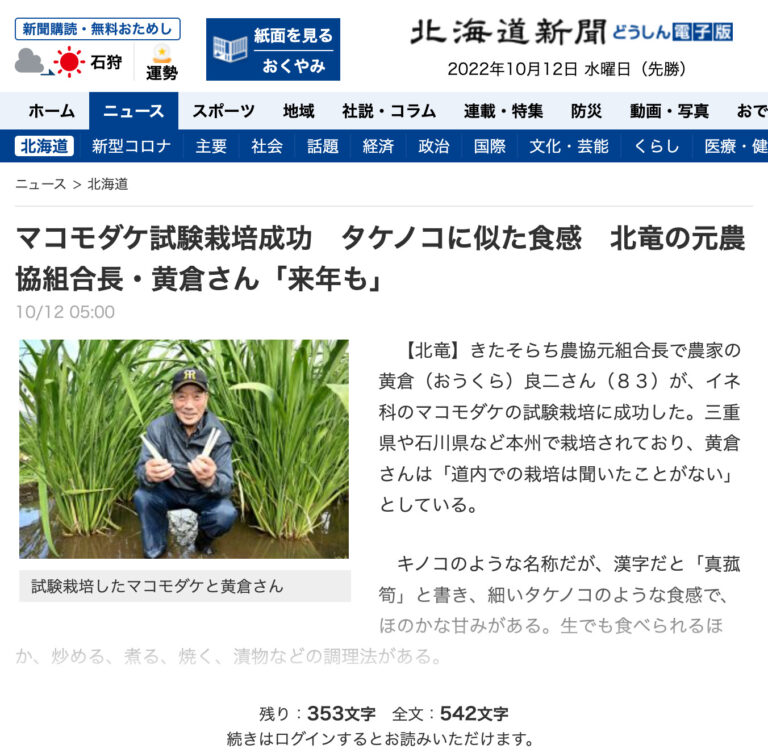
On Wednesday, October 12, 2022, the online edition of the Hokkaido Shimbun newspaper reported, "Test cultivation of Makomodake succeeds, texture similar to bamboo shoots. Former Hokuryu Agricultural Cooperative Association..."
Reference video
What is Makomodake? ~ Introducing everything from natural recycling methods of growing Makomo to how to eat it! (Konohana Family Agricultural Cooperative, Fujinomiya City, Shizuoka Prefecture)
Izumo Taisha Shrine Ryoden Festival (June 1, 2017)
◇ Photography and editing: Noboru Terauchi Interview and text: Ikuko Terauchi