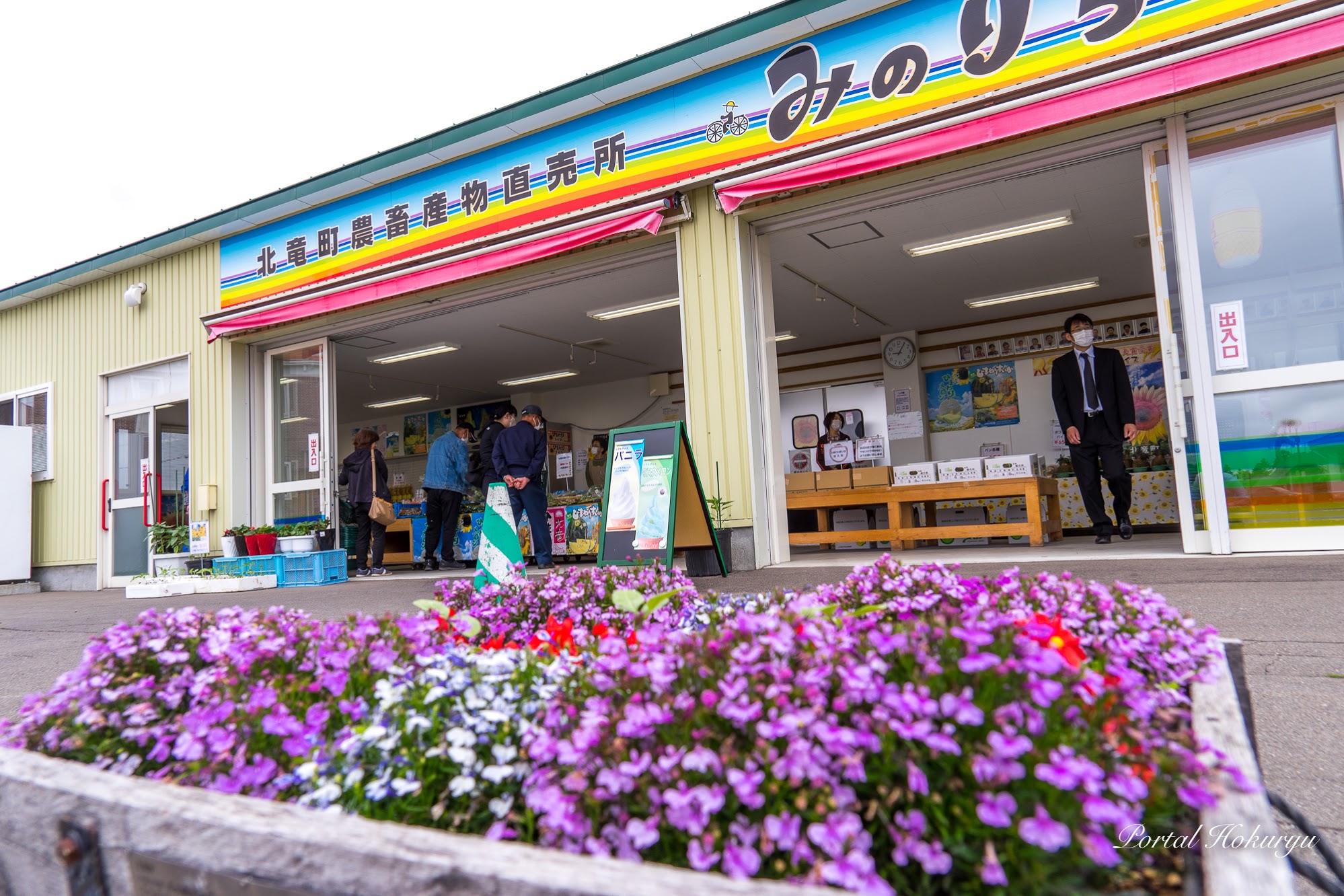
Thursday, June 25, 2020
On Sunday, June 21st and Monday, June 22nd, a location shoot for a documentary film was held in Hokuryu Town by Masahiko Yamada (former Minister of Agriculture, Forestry and Fisheries, lawyer, and advisor to the Association for Protecting Japanese Seeds) and film director Masaki Haramura. The film is about "Seed and Food Safety."
Mr. Yamada, Director Haramura and their party arrived in Hokkaido on Friday, June 19th, visiting places such as "Zi Beef," a free-range cattle farm in Samani Town, and "Toma Green Life Co., Ltd.," an agricultural production corporation that operates a large-scale organic farm in Toma Town, before visiting Hokuryu Town on their final day. On Sunday, June 21st, they held a discussion meeting on the theme of "Seeds and Seedlings," and in the early morning of the following day, Monday, June 22nd, they filmed an interview at a Kurosengoku soybean field.
- 1 About the Seed Act and the Seedlings Act
- 2 conference
- 2.1 Mr. Yamada and Mr. Haramura and their team
- 2.1.1 Masahiko Yamada (former Minister of Agriculture, Forestry and Fisheries, advisor to the Association for Protecting Japanese Seeds, and lawyer)
- 2.1.2 Masaki Haramura (Documentary film director)
- 2.1.3 Namie Endo (Yamada's secretary)
- 2.1.4 Mr. Mamoru Segawa (CEO, Toma Green Life Co., Ltd., an agricultural production corporation)
- 2.1.5 Masayuki Nagasaka (organic farmer)
- 2.1.6 Yoshimi Takashima (Community Communicator)
- 2.2 Participants from Hokuryu Town
- 2.3 General MC: Ryoji Kikura
- 2.4 Greetings from Mayor Yutaka Sano
- 2.5 Greetings from Masahiko Yamada
- 2.6 Director Masaki Haramura's story
- 2.6.1 Humans need water, air, and food
- 2.6.2 A highly spiritual farmer
- 2.6.3 A film on the theme of "seed and food safety"
- 2.6.4 Professor Yamada's unwavering will and spirit, and his warm-hearted heart
- 2.6.5 I want to express opposing ideas
- 2.6.6 Managed by multinational corporations
- 2.6.7 The importance of mutual dialogue
- 2.6.8 I want to photograph and convey the wonders of Japanese agriculture.
- 2.7 The story of Mamoru Segawa
- 2.8 exchange of opinions
- 2.1 Mr. Yamada and Mr. Haramura and their team
- 3 Exchange meeting
- 4 The next day, we went on location to shoot at the Kurosengoku soybean field.
- 5 Addendum: The official website for "Whose Seed is It?" is now open! Applications for independent screenings are now open (Shindo Fuji Corporation)
- 6 Other photos
- 7 Related articles and sites
About the Seed Act and the Seedlings Act
seed method
The Seed Act (Major Agricultural Crop Seed Act) is a Japanese law (Act No. 131) enacted on May 1, 1952 (Showa 27). The purpose of this law is to have the government manage the production of seeds for major agricultural crops (rice, soybeans, wheat, etc.) and to carry out field inspections and other measures.
Abolition of the Seed Act
The Seed Act will be abolished on April 1, 2018. The national government's uniform guidance to prefectures will be abolished, and the authority to promote varieties will be delegated to each local government, such as city, town, and village. The decision to abolish the Act was made in line with the aim of strengthening the competitiveness of agriculture through private sector participation.
The production of seeds, which is a shared regional asset, will be entrusted to the private sector, raising concerns that this could lead to soaring prices due to seed monopolies by multinational corporations and the domination of Japan's seed market by private companies.
Seed method
The Seeds and Seedlings Act is a Japanese law that was promulgated on May 29, 1998, that provides for the protection of rights regarding the creation of new plant varieties. It stipulates that anyone who creates a new plant variety can exclusively obtain the right to breed that new plant variety by registering that new variety.
Proposed amendments to the Seed and Seedlings Act: Two main points
1. Restricting the export of seeds overseas and restricting cultivation outside of specified areas
2. Implementing a licensing system for self-propagation of registered varieties
Please note that only registered varieties are subject to a licensing system for self-propagation; native species, common varieties, and unregistered varieties do not require a licensing application and there are no restrictions on self-propagation.
(References:Ministry of Agriculture, Forestry and Fisheries website: Bill to amend the Seed and Seedlings Act)
Seed and Seedlings Act amendment bill expected to be postponed (Japan Agricultural News, May 21, 2020)
It is expected that the bill to amend the Seed and Seedlings Act will not be passed in the current Diet session.
(References:Japan Agricultural News: Seed and Seedling Law amendment postponed; farmers' interests must be put first)
conference
On the evening of Sunday, June 21st, a discussion meeting was held at Sunflower Park Hokuryu Onsen with Mr. Yamada, Village Superintendent Hara and other relevant parties, along with Mayor Sano Yutaka, JA Kitasorachi Hokuryu Branch Manager, directors of the Kurosengoku Business Cooperative, and Hokuryu Town officials.


Mr. Yamada and Mr. Haramura and their team
- Masahiko Yamada (former Minister of Agriculture, Forestry and Fisheries, advisor to the Association for Protecting Japanese Seeds, lawyer), Masaki Haramura (documentary film director), Namie Endo (Yamada's secretary), Mamoru Segawa (CEO of Toma Green Life, an agricultural production corporation), Masayuki Nagasaka (organic farmer), Yoshimi Takashima (community communicator)

Masahiko Yamada (former Minister of Agriculture, Forestry and Fisheries, advisor to the Association for Protecting Japanese Seeds, and lawyer)

Masaki Haramura (Documentary film director)

Namie Endo (Yamada's secretary)


Mr. Mamoru Segawa (CEO, Toma Green Life Co., Ltd., an agricultural production corporation)

Masayuki Nagasaka (organic farmer)


Yoshimi Takashima (Community Communicator)


Participants from Hokuryu Town
Mayor Yutaka Sano, Hokuryu Town Council Member Keiko Ozaki, JA Kitasorachi Hokuryu Branch Manager Tadao Hoshino, Kurosengoku Business Cooperative Association Chairman Yukio Takada, Executive Director Masaaki Tsuji, Director Kazuo Kimura, former JA Kitasorachi Representative Director and Chairman Ryoji Kikura, and Hokuryu Town Community Supporters Noboru and Ikuko Terauchi. All are members of the Hokkaido Seed Association (Chairman Tokuji Hisada).


General MC: Ryoji Kikura


Greetings from Mayor Yutaka Sano


"Coach Haramura is originally from Chiba Prefecture, and Hokuryu Town was settled in 1893 by a group of pioneer immigrants from Motono Village (now Inzai City) in Chiba Prefecture. This year marks the 128th anniversary of that.
As of June 1, 2020, the population is 1,778, making it a small town even by Hokkaido standards. The population peaked at 6,317 in 1960. It is a depopulated town that has fallen to less than two-thirds of its original size in roughly 60 years. The population is still declining, but has recently been slowing down. As is the case in any town, the issue of population decline is a major challenge.
This year, the Sunflower Festival has been canceled due to the effects of COVID-19. Although sunflowers will not bloom at Sunflower Village, we will continue to prepare the soil for Sunflower Village. We plan to plant oats, plow them in, then sow more oats and plow them in, and then plant autumn wheat. Next year, we will continue to prepare the soil by adding compost after the snow melts.
For the past 34 years, Himawari no Sato has never been left fallow. This year, we will turn this crisis into an opportunity, and with an eye to the next 10 to 20 years, we will focus on creating soil that will allow good sunflowers to bloom.
Hokuryu Town is a town of agriculture and sunflowers. In 1990, former union president Kikura led the town in declaring itself "a town of food production that protects the lives and health of the people," and about 30 years have passed since then. Based on this declaration to deliver safe and delicious food to consumers, we are involved in rice farming and agriculture.
In March 2017, the Hokuryu Sunflower Producers Association received the Japan Agriculture Award Grand Prize. The award ceremony was held at the NHK Hall in Shibuya, and the award certificate was presented by Agriculture, Forestry and Fisheries Minister Yuji Yamamoto and NHK Chairman Ryoichi Ueda.
Furthermore, in November 2018, Kurosengoku soybeans were selected as an excellent example in the Ministry of Agriculture, Forestry and Fisheries' 5th Discover Treasures of Rural Areas awards, and the award was presented at the Prime Minister's Official Residence. At the time, the Minister of Agriculture, Forestry and Fisheries was Yoshikawa Takamori, but today we are joined by former Minister of Agriculture, Forestry and Fisheries Yamada Masahiko, and we are grateful for this opportunity.
"I would like to have a long-awaited conversation with you tonight, within the time allowed, to hear from you, the teachers and the coaches. I look forward to working with you," said Mayor Sano in his opening remarks.
Greetings from Masahiko Yamada


Mr. Masahiko Yamada
Born in Nagasaki Prefecture in 1942 (Showa 17). Attorney. Graduated from the Faculty of Law, Waseda University. After passing the bar exam, he opened a ranch in his hometown of Goto. He closed his ranch management due to the oil crisis and devoted himself to his law career. He then ran for the House of Representatives and was appointed Minister of Agriculture, Forestry and Fisheries in June 2010 (Heisei 22). He subsequently served five terms as a member of the House of Representatives.
In addition to his work as a lawyer, he currently works on issues such as the TPP and the abolition of the Seed Act, and gives lectures and holds study sessions in various locations.


"This time, I came to Hokkaido for the first time in a long time. I arrived on Friday, June 19th and visited a ranch in Samani Town that produces free-range wild cattle called Ji Beef. It was a truly wonderful place, and I realized that this is the true essence of a ranch, and that it could only be realized in Hokkaido.
In fact, the Ministry of Agriculture, Forestry and Fisheries issued a "policy prohibiting open grazing (cattle, sheep and pigs)." However, in an unusual move, this "prohibition on open grazing" was deleted on Friday, June 12th.


Seed and Seedlings Act Revision: Prohibition of self-seeding is the most likely outcome
First, I would like to talk about the revision of the Seed and Seedlings Act. Soybeans, rice, wheat, and other staple foods in Japan are managed by the national government, and the prefectural governments develop high-quality varieties and provide them to farmers in a stable manner. This law will be abolished.
At the time, the government said, "The role of the public sector, both as a local government and as a nation, has come to an end. From now on, we will utilize the private sector and have private companies take over all seed management."
In fact, the Ministry of Agriculture, Forestry and Fisheries is promoting "Mitsuhikari," a privately developed rice variety developed by Mitsui Chemicals Agro Inc. Mitsuhikari is an F1 variety (hybrid variety) and is 10 times more expensive than "Koshihikari." They say that the future is the era of F1 varieties.
At the same time, the Agricultural Competitiveness Enhancement Support Act (Act No. 35 of 2017) was enacted. This law promotes the provision of excellent breeding knowledge developed by the National Agriculture and Food Research Organization (NARO) and excellent breeding knowledge from each prefecture to the private sector. These were not reported in the media.
Hokkaido has also issued a notice that it is OK for the prefecture to continue producing seeds and providing them to farmers, but that in the meantime all relevant knowledge must be provided to the private sector. The prefecture transferred the Japanese rice variety "Yumepirika" to Monsanto Japan Ltd., which developed the new variety "Tone no Megumi," which has been on the market for the past 10 years.
Their main goal was to first abolish the existing public seed law, transfer the excellent knowledge of each prefecture to private companies and large corporations, and then to ``ban self-seeding.''


We asked director Masaki Haramura to make a film about "Seeds and Seedlings"
I met Director Haramura two years ago. Seeds and seedlings are the lifeblood of farmers. Information about the "ban on self-seeding" is not reported at all in the mass media. So, with the desire to let as many people as possible know about the "Seed Law Revision," I asked Director Haramura if he would make a film about "Seeds and Seedlings."
In Hokkaido, Tokuji Hisada (Chairman of the Hokkaido Seed Association, Visiting Professor at Hokkaido University, and former editorial committee member of The Hokkaido Shimbun Press) and Ryoji Kikura are working hard at the Hokkaido Seed Association. I have known Kikura since we established the Food and Agriculture Revitalization Council 10 years ago, when he became a permanent director.
We are in contact with everyone and are engaged in discussions about the Seed and Seedlings Act. During the filming of this movie, we visited Toma Green Life, run by Mamoru Segawa, who grows his own rice, and Hotaru Farm, run by Kazuhisa Ito in Tokachi, who grows his own wheat and soybeans.
I am very grateful to have come across Kurosengoku soybeans, a superior black soybean variety recommended by the Ministry of Agriculture, Forestry and Fisheries.
When the region changes, the country changes.
Following the abolition of the Seeds and Seedlings Act, 19 prefectures have now enacted and implemented their own seed ordinances. Furthermore, 27 governors have made announcements, and the movement to protect the seeds unique to each prefecture is spreading. If things continue as they are, we will gain support from 32 prefectures.
The Ministry of Agriculture, Forestry and Fisheries was initially opposed to the Seed Ordinance, but has recently changed its stance to welcome it. In the Diet, the Liberal Democratic Party has agreed to deliberate on the "Bill to Abolish and Revive the Seed Law" proposed by the opposition parties.
The TPP agreement has given multinational corporations control over seeds and agriculture. I am convinced that if we resist this from the local level, we will be able to protect Japan's agricultural policy. I would like to fight alongside you all. Thank you.
"I'm looking forward to seeing the Kurosengoku soybean fields tomorrow. Thank you very much for coming today," said Yamada politely.

Director Masaki Haramura's story


Director Masaki Haramura
Born in Chiba Prefecture in 1957 (Showa 32). After graduating from Sophia University, he worked as a freelance assistant director on documentary films and television programs. He joined Sakura Film Company in 1985 (Showa 60). His major works to date include "The Diving Woman Liang-san" (2004), "People Who Cultivate Life" (2006), "Satoyama Kids" (2008), the NHK ETV special "Rice Farmers Facing the Nuclear Accident" (2011), NHK Educational TV "What Have the Japanese Aimed for? Part 8: Takahata, Yamagata - Aiming to Be the Best Rice Farmer in Japan," BS Premium's "New Japan Topography" (2014), and the documentary film "Musashino" (2018).

"I am making documentary films based on agriculture. I only know a little about agriculture, but I have been filming in various villages for many years since I was a teenager. I have had the opportunity to come into contact with the feelings of farmers, so I believe I have some understanding of them.
Humans need water, air, and food
The reason why we have been involved in agriculture is because humans need water, air, and food to survive.
Ever since I was growing up during the period of rapid economic growth, I have felt that Japan has been cold towards agriculture. And when I was filming in villages, I found it strange that in conversations between farmers and city dwellers, they had different perspectives on the world and were unable to understand each other.
A highly spiritual farmer
In my long-term relationships with people who are seriously involved in agriculture, I have come across many people who are highly spiritual.
During my interviews, I have come to realize that the words these people speak are very meaningful. For example, there are many people who have only graduated from junior high school but who are intelligent enough to become scholars. Some speak like poets, others like philosophers, and they speak in very sophisticated language.
Meeting such wonderful people makes me happy and comfortable. Even when I'm interviewing them, it's fun and exciting. Once again, I'm impressed by meeting people who have such wonderful ways of thinking and who are doing their jobs.
I continue to make films because I want to share with as many people as possible the wonderful and wonderful aspects of these farmers.

A film on the theme of "seed and food safety"
The theme of this film is "Seeds and Food Safety." The more I learn about food safety, the more I am convinced of the importance of agriculture as the foundation of Japanese life. I began filming around February of last year, and the more I worked, the deeper I got into the subject.
Professor Yamada's unwavering will and spirit, and his warm-hearted heart
I first met Professor Yamada when I was serving as a judge at the awards ceremony for a journalist show. After that, I had more contact with Professor Yamada and he asked me to make a film for him.
Up until now, I have been conducting research in a village for at least one year, usually two to three years, and in some cases as long as 20 years, in a community-based approach for many years. Therefore, this film on the Seed Law is different from what I have done before, as it focuses on political and social issues, and it is a high-level, extremely difficult challenge to tackle, so I was worried about whether I could do it.
However, as I listened to Professor Yamada's talk and studied more, I realized that this was a huge issue in agriculture and became fascinated.
Professor Yamada has a wealth of knowledge and has much to teach us, and he has strong, unwavering beliefs. I have made many agricultural films so far, and one thing I have always felt in common is the "unwavering will and spirit" of farmers. I myself don't have an unwavering spirit, so I like this kind of "unwavering spirit."
During this shoot, I felt that an aura of humanity exudes from the back of Professor Yamada as he gets closer to the hearts of the farmers and listens carefully to their stories. I was impressed by the kindness of Professor Yamada's heart, as he gently gets closer to the hearts of those who are suffering and in pain, and takes them on as if they were his own.

This film tends to focus on social problems and difficulties, but at the same time, I wanted to capture the humanity and scenes that Professor Yamada possesses. I feel that Professor Yamada's humanity is brimming with human emotions, such as his resolute and conviction-driven attitude in facing difficult situations, and his ability to fully accept things that he can empathize with.

I want to express opposing ideas
When it comes to the topic of seed laws and pesticides, there are polarizing thoughts and opinions. Rather than unilaterally pushing one side of the argument, I wanted to make a film that makes people think, even if their opinions differ, that they might want to listen to what these people have to say.
Managed by multinational corporations
Among the various opinions regarding the Seed and Seedlings Act, there are issues behind the scenes, such as large corporations monopolizing seeds in the context of globalization. The existence of these masterminds is not widely recognized, and is rarely covered in the media. I feel that even among farmers, there are many who are unaware of these masterminds.
By bringing this largely hidden part to the surface, I hope to make a film that will enable people with different opinions to understand each other and pursue the essence of each other, as well as make more people aware of the reality of the situation.
Although this is a very difficult task, my visit to Hokkaido this time has made me realize even more its importance.
The importance of mutual dialogue
There is no right or wrong; both sides have their good and bad points, and I don't think there is any one thing that is 100% correct. Rather than continuing to have differences in opinion, I think it would be better if people met, talked, and engaged in mutual dialogue.
I want to photograph and convey the wonders of Japanese agriculture.
The farmers I met were all very charming people, and their words and actions were persuasive.
Most city dwellers do not know or understand the specifics of rural areas, agriculture, and farms. I feel that it is extremely important to help people to have a heartfelt feeling of gratitude towards the farmers who support people's lives.
"The landscape is not entirely created by nature, but is made possible in large part by the efforts of farmers. I have a strong desire to convey the true state of affairs of these farmers. As long as I am still able to walk, I would like to travel around Japan's rural areas and convey the wonders of Japanese agriculture," Director Haramura said sincerely.

The story of Mamoru Segawa


Mr. Mamoru Segawa
He is the creator of Toma Town's "Densuke Watermelon." He currently practices organic farming in an area of over 100 cho. He founded the Toma Green Life Research Association in 1990 (Heisei 2). He produces specially cultivated rice and incorporated the agricultural production corporation Toma Green Life LLC in 1998 (Heisei 10), and continues to vigorously pursue organic farming.
"The setting for this event began with an order from Tokuji Hisada, chairman of the Hokkaido Seed Association, who asked us to introduce farmers who are harvesting seeds.
Toma Green Life Agricultural Production Corporation Limited (Toma Town)
Our organization practices organic farming on 10 hectares of paddy fields, as well as vegetables, field crops, and greenhouse horticulture, all of which are grown organically.We have not used any chemical fertilizers on our 117 hectares of fields for the past 10 years.
God's voice: "Change the world"
Today, with the advancement of networks, we can grasp the situation in the world by simply taking one step outside, and we can obtain clear information about the current situation in Japan every day. Despite this, I think there are still people who wonder why the situation in Japan is not changing very much.
However, with the current overlapping of various problems, such as issues with pesticides and seeds, I feel that we are now at a time of great change from God, who is telling us, "It's time to change the world."
All sorts of information about these issues is available online. One reason for this is data showing a clear correlation between the amount of pesticides used and the incidence of developmental disorders in children. When I saw this data, I felt that we farmers, as agricultural producers, needed to change the way we do agriculture.
Without exaggerating, I feel that unless we change the way we do agriculture, we may become criminals who create disease. I feel that farmers need to approach the "manufacturing" of agriculture with this level of awareness.
Food that sustains life
"I believe that now is a great opportunity for farmers to take seriously the idea that 'food is the most important thing to sustain life,' and to change their mindset once again. I strongly believe that the time has come for rural farmers to speak out loudly in order to change Japanese agriculture. I look forward to your continued support," said organic farmer Mamoru Segawa.


exchange of opinions
An exchange of opinions took place with the participants, led by Mr. Yamada and Director Haramura.


Exchange meeting
The social gathering took place at a different venue. Guests enjoyed heartfelt food from Sunflower Park Hokuryu Onsen, sipped alcohol, and deepened their friendships in a harmonious atmosphere.


The next day, we went on location to shoot at the Kurosengoku soybean field.
The next morning, a video recording of a conversation between Yamada and members of the Kurosengoku Business Cooperative was held in the Kurosengoku soybean fields.
Mr. Yamada listened closely to the honest words of the producers and took them seriously.


Japanese agriculture is changing as we become aware of the various problems hidden in the Seed and Seedlings Act and the unknown world.
I am deeply moved by your drive to carefully and meticulously move forward step by step to shed light on the ever-changing world of agriculture, and I am truly grateful for the wonderful connections we have made. Thank you so much!!!
With boundless love, gratitude, and prayers to the great spirits of farmers who protect seeds that contain life and cultivate food that sustains life...

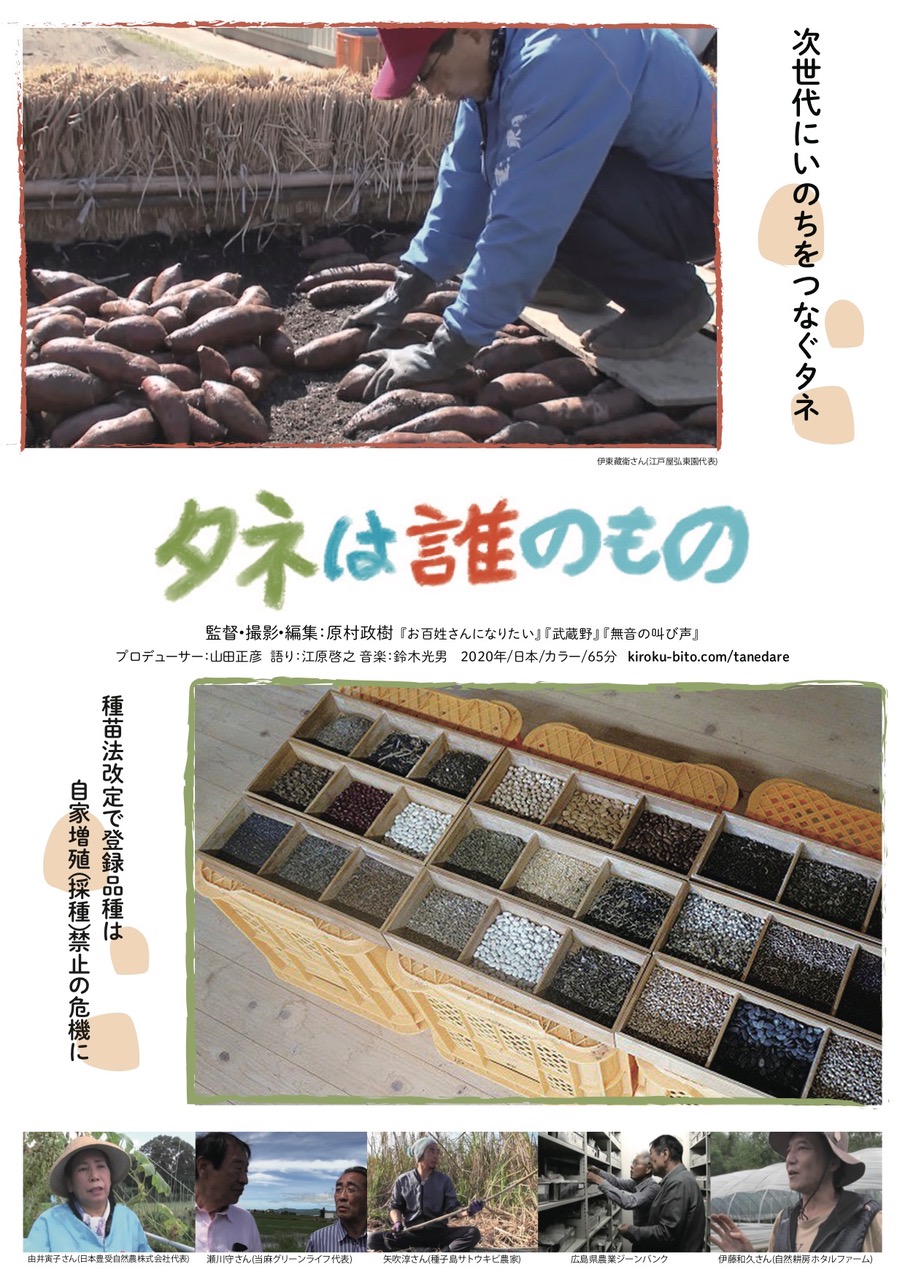
Addendum: The official website for "Whose Seed is It?" is now open! Applications for independent screenings are now open (Shindo Fuji Corporation)
Other photos
Related articles and sites

Mr. Masahiko Yamada
Masahiko Yamada: Don't let the revision of the Seed and Seedlings Act ruin the nation's 100-year plans
Director Masaki Haramura
・Theatrical trailer for the movie "I Want to Be a Farmer"

Mr. Mamoru Segawa
For the future "Seeds are yours" by Mamoru Segawa and Ryoji Kikura, Hokkaido Organic Agriculture Research Association
Mr. Ryoji Kikura
For the future: Ryoji Okura, a pioneer of organic farming in Hokkaido
◇ Photography and editing: Noboru Terauchi Interview and text: Ikuko Terauchi