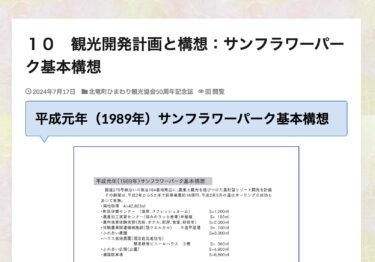
1985: Mt. Edai Development Plan (Ski Resort)
Hokuryu-Edaidake Comprehensive Forest Recreation Development
Etai Resort (Third Sector Sanei Sports)
- Ski slope area: 85.40 hectares
- Youth Resort Center: Reinforced concrete structure, 10,734 m²; Gymnasium: Reinforced concrete structure, 1,650 m²
- Walking trails, campgrounds, sports grounds, tennis courts, athletic facilities
- Double-track interlocking ropeway with a capacity of 150 people (3,386m)
- First half plan: Approximately 4.128 billion yen
- Maintain and continue: Approximately 1.462 billion yen
Two-seater connecting pair lift (300m)
6-seater cabin (2,100m)
At the time, the bubble economy was creating a resort boom, and Hokuryu Town also considered the "Edai-dake Development (Ski Resort) Plan." However, this plan was plagued by environmental damage to Shokanbetsu-dake Quasi-National Park and Uryu-numa. Furthermore, the "Sunflower Concept Plan" was enacted in 1990, and the plan was eventually cancelled.
Compared to Kamui Ski Links, the Kamui Gondola (for 4 people) is 2,327m, and the Keidai Resort plan will make the ropeway 1km longer. The plan is to build a ropeway at roughly the same altitude as Furano Ski Resort, with the Kitanomine Gondola (for 6 people) at 2,958m, so the Keidai development will be roughly the same size as Furano Ski Resort.
Uryu Numa subsequently became a Ramsar site in 2005. The Ramsar Convention is an international treaty aimed at protecting and managing wetlands.
However, with the collapse of the bubble economy, resort areas have lost their vitality, with many going bankrupt or becoming ruins. However, Niseko Resort is the only one that is revitalizing thanks to the inbound tourism effect.
If this Keigaku Resort had been implemented, it might have become as lively as Niseko, or it might have become deserted like Canadian World in Ashibetsu, Coal History Village and Mount Racey Ski Resort in Yubari, and Kiroro Resort and Fukagawa Ski Resort in Akaigawa.