Tuesday, May 17, 2022
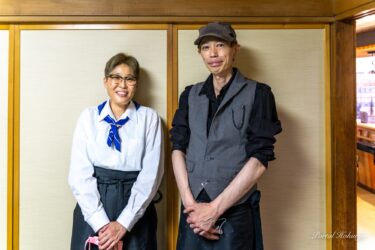
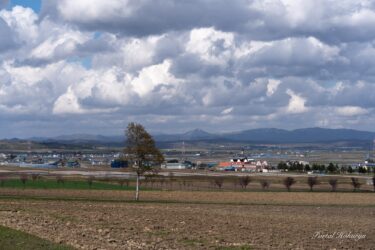
This year, for the first time, dry-seeded rice cultivation is being carried out on the farmland of Yuki Takada (46 years old), who farms on about 80 cho of land in Hokuryu Town.
The area of land for direct seeding in dry fields is about 4 cho, and the variety is "Emimaru," a direct seeded rice that is suited to the Hokkaido climate. It is a new variety that has excellent seedling establishment in low temperatures and disease resistance, and is expected to become more widely used in direct seeding cultivation.Reference: Hokkaido rice LOVE)。
Dry field direct seeding cultivation
Dry-field direct cultivation does not require plowing, and is a technique that saves labor and reduces costs compared to paddy rice cultivation.
The field is leveled using a laser leveler, and then sowing, tamping, and covering the seeds with soil are carried out. After that, watering is carried out, herbicide is sprayed, and seedlings are grown.
Plowing and field leveling
Leveling the field is considered important for seedling establishment, water management, and weed control.
Laser Leveler
The laser emitted from the laser emitter is used as the reference height by the receiver attached to the blade, which detects the height and controls the blade height to a constant level via a hydraulic controller.
As a result of this work, the difference in elevation of the field is said to be less than 3 cm.


Sowing work: Sowing with a grain drill
Directly grown rice "Emimaru"

Seed input

sowing


Suppression work and covering seeds with soil
To ensure stable seedling establishment and prevent water leakage, we use a Cambridge roller to tamp the soil.


Koki Takada and his John Deere 6175M tractor
Yuki Takada rides a John Deere 6175M tractor like it's his own limbs.

Water filling work


After watering, spray herbicide and wait for germination.
In this first attempt, they overcame difficulties through trial and error, including malfunctions of the machinery, and boldly took on the challenge of pioneering a new type of dry-field direct seeding cultivation, and we send our boundless love, gratitude, and prayers to them...
Related articles

![Mr. Koki Takada [Hokuryu Town] - Hokuryu Town Portal (Hokkaido) - Japan's No. 1 Sunflower Village](https://lh3.googleusercontent.com/VObf1kbvMs8KaLsut_lSlm999SjzxXpjxIrJgqACNhevhaVBqwpLCxa6k-kthdngh-8UUjxZXlJIdz9JwAjgSxp610qW5BoTh47Ok00PtSa_MR1FFDF7MbdcqA4cmMfI0RHSFm-Dcbil3zherWjzGgbqoipFWPjYSwAyflDpQgkf8TtmbZTAKIx9Fpw-rK-uR3VbcqslfzwUiOoO_J7P_6wBVDIaQx3mux-uUaSAdMDDkfFwxIKfsr6730tlXOh62L9BdDfj9sfNZ0M5FULi8OUnFGZUbc2tpZC06s9UPebAHg65-VGmr07L6-ihI4LyGK6HkC3E40-w3qDheZp6OUCg78EDXs4b3iw-cK0w0wllCvvTIIZx9W1yfFJV-ho2rZ7ga2qFiGbDWIHxh187bcHf65g0i1HafivL9wgl4oFfzlFSclDP8x6fz5hg5poqVQ4qbtehukvBXpTP7fzF70Uanw0iVvp0P7qkhPEl8sgUpzh2kG-pt4A2Q5UcsBoliRd_Aku5G2nG1hXMHMtwgT7rRuIiL8u_pQf1qnz-xExLYEJgNWfEu-sH0TFBPHu3-HxkelZoPHOkuPtCc9D9O_VLW2x9Qz2NjhJDaRYJ8rkYMO5_WMi-iSsWpWpHtmwT0gqOkv5DCFy03fiVdBH067Oxz306a4PJqy9SV5dZiLJnd2KnABLya5emChnfyVpuwb6jTAfdhKMNz9H4V-yMHQAY5ctd4NRNhi3LhW_0TEwa9rY=w160-h150-no)
◇ Photography and editing: Noboru Terauchi Interview and text: Ikuko Terauchi